
Why Do Korean Parents Start With Mathematics?
Ask many Korean parents which subject must be secured first for admission to a highly selective university and the answer will often be mathematics.
The reasoning is not that Korean, English, history or social studies are unimportant. All can determine university admission. The difference is the structure of learning.
Mathematics is cumulative. A student who fails to understand algebra, functions, equations and basic calculus cannot simply memorize a later chapter and move on. Each stage depends heavily on the previous one.
This produces a distinctive educational strategy in Korea: front-load mathematics, build the foundation early and use the later high-school years to optimize the other subjects.
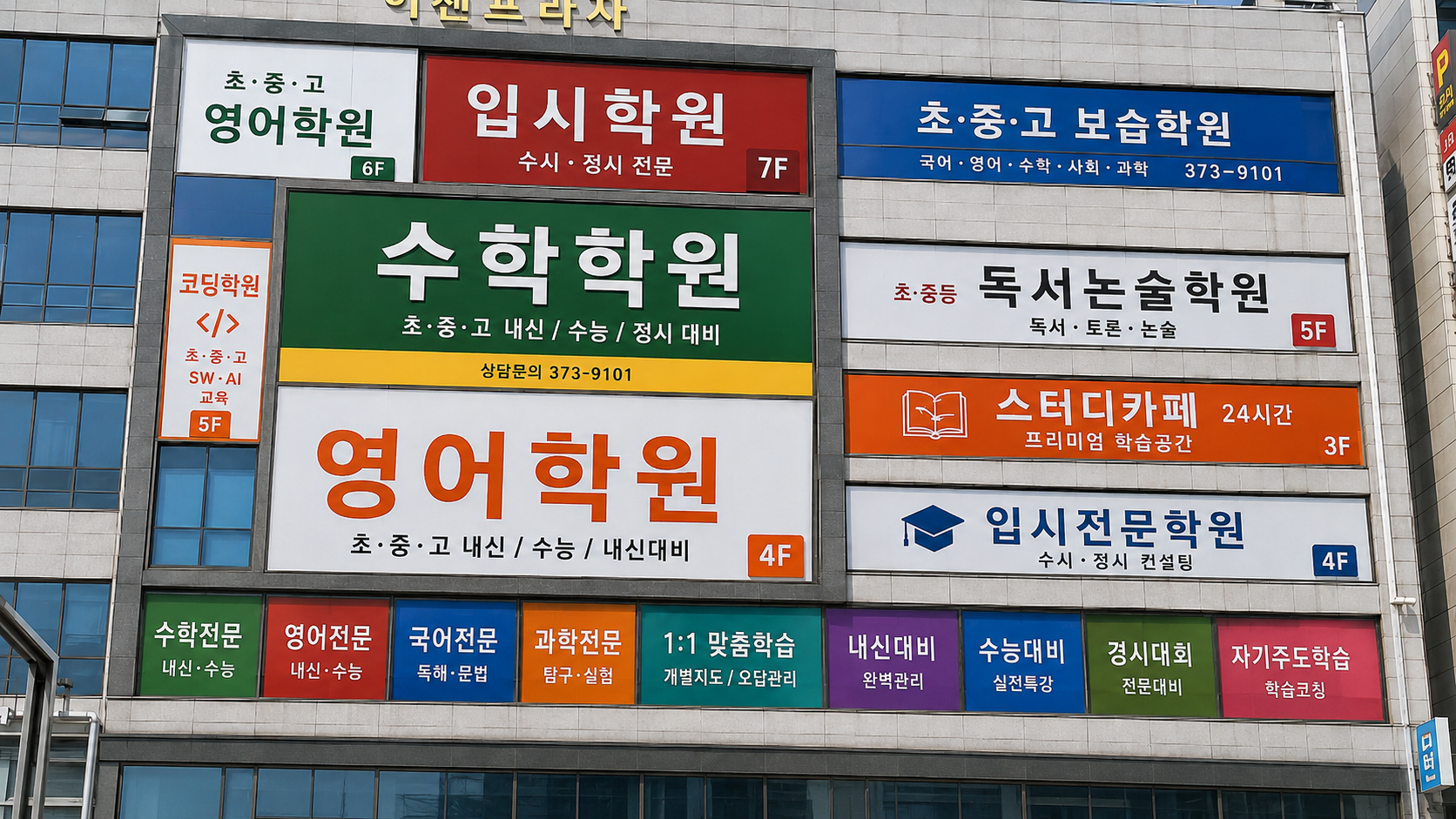
That strategy has helped create one of the world's most concentrated private mathematics-education markets, centered on Seoul's Gangnam district and especially Daechi-dong.
Korea Spent KRW 27.5 Trillion on Private Education in 2025
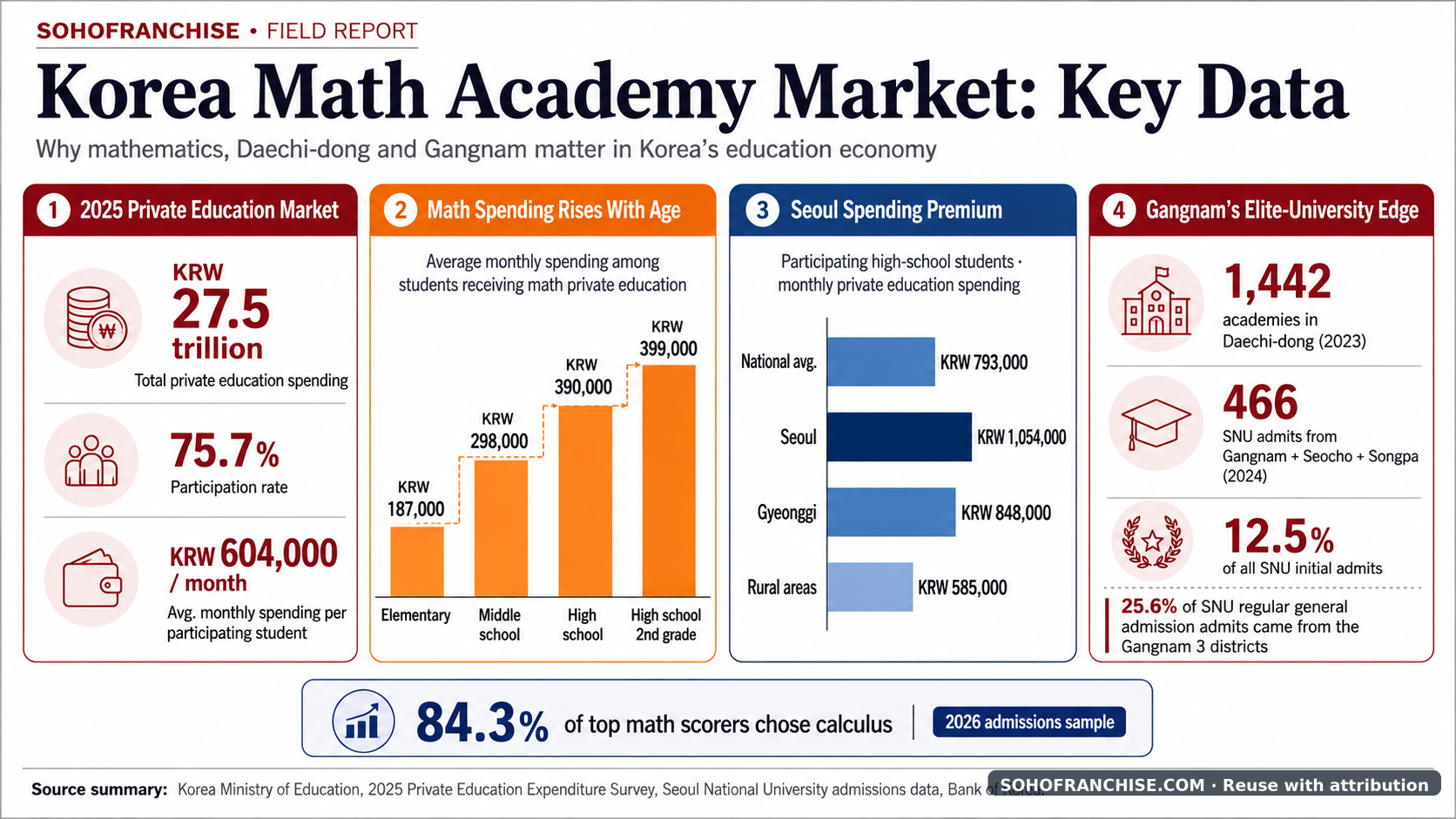
According to the 2025 Private Education Expenditure Survey conducted jointly by Korea's national statistics authority and the Ministry of Education, Korean families spent approximately KRW 27.5 trillion on private education for elementary, middle and high-school students.
| 2025 Private Education Indicator | Result |
|---|---|
| Total private education spending | KRW 27.5 trillion |
| Overall participation rate | 75.7% |
| Average monthly spending — all students | KRW 458,000 |
| Average monthly spending — participating students | KRW 604,000 |
| Participating high-school students | KRW 793,000 per month |
The market therefore remains enormous even as Korea's school-age population declines.
More importantly for education businesses, average spending among students who actually use private education increased in 2025 even while the total student population and overall participation rate declined.
This means the Korean education market is gradually becoming smaller in student numbers but more concentrated among families willing to spend heavily.
Mathematics Becomes More Expensive as Students Get Older
The national data shows why mathematics is particularly important to the private academy industry.
Across all students, average monthly private-education spending in 2025 was KRW 131,000 for English and KRW 128,000 for mathematics. But among students actually receiving private education, mathematics spending rises sharply by age.
| Students Receiving Math Private Education | Average Monthly Spending |
|---|---|
| Elementary school | KRW 187,000 |
| Middle school | KRW 298,000 |
| High school | KRW 390,000 |
| High-school 2nd grade | KRW 399,000 |
The second year of high school is particularly important. Students are simultaneously preparing for school grades, the CSAT and university-specific strategies, while advanced mathematical content becomes substantially more difficult.
For an academy, this creates an unusually attractive business characteristic: a successful mathematics student can remain with the same academy for several years, while the monthly value of that student tends to increase as university entrance approaches.
Why Calculus Became the Symbol of Korea's Elite Admission Race
Under the current CSAT system through the 2027 admission cycle, students take common mathematics and select one of probability and statistics, calculus or geometry.
For students targeting medicine, engineering, computer science and other highly selective STEM programs, calculus has historically been strongly favored.
A Seoul Metropolitan Office of Education admissions sample for the 2026 admission cycle estimated that approximately 84.3% of mathematics first-grade scorers had selected calculus. Only about 14.5% selected probability and statistics and roughly 1.2% geometry.
This does not mean calculus automatically produces a first-grade score. Strong mathematics students are themselves much more likely to select calculus, creating an important selection effect.
Nevertheless, the statistic explains why Korean parents associate advanced mathematics with admission to elite universities.
The psychological logic becomes simple:
If a student reaches high school without a strong mathematics foundation, recovering enough ground to compete with students who began advanced mathematics several years earlier can be extremely difficult.
But the Rules Change in 2028
Korea is changing the CSAT beginning with the 2028 university admission cycle.
The mathematics elective system will disappear. All students will take a common examination covering algebra, Calculus I, and probability and statistics.
Advanced Calculus II and geometry will not be included in the CSAT itself.
This is important because the often-heard claim that every Korean student must master advanced calculus to enter a good university will become less accurate.
However, calculus does not disappear. Calculus I — including derivatives, antiderivatives and definite integrals — remains part of the national examination.
In addition, students aiming for highly selective STEM programs can still take advanced mathematics courses in high school, and universities can examine those academic records.
For the private-education industry, therefore, the 2028 reform changes the product but is unlikely to eliminate demand for advanced mathematics instruction.
Why Is Everything Concentrated in Gangnam?
Gangnam did not become Korea's private-education capital simply because several famous mathematics teachers decided to locate there.
The ecosystem developed over decades through a reinforcing cycle:
- High-income and highly educated families moved into the district.
- Strong schools attracted additional education-oriented households.
- Large numbers of academically ambitious students created demand for specialized academies.
- Successful instructors moved where the strongest students were concentrated.
- Academies accumulated admissions data, teaching materials and reputation.
- Families from outside Gangnam began commuting to Daechi-dong.
- Educational demand increased housing demand, further concentrating affluent families.
Once this network reached sufficient scale, it became difficult for another area to reproduce it quickly.
Daechi-dong Is Not Just a Neighborhood — It Is an Education Cluster
Daechi-dong is generally regarded as the center of Korea's private academy industry.
Registration-data-based analyses counted approximately 1,442 academies in Daechi-dong in 2023, making it the country's largest single academy district.
The real educational ecosystem is even larger because students travel into Daechi from neighboring areas and because registered academies may operate multiple classes, instructors and specialized programs.
The Gangnam-Seocho Office of Education now publishes updated academy registration data every month, illustrating how large and dynamic the local education business has become.
How Many of Those Are Mathematics Academies?
There is an important statistical problem.
Korea does not have a perfectly clean national category called “mathematics academy.” Many institutions are registered under broader categories such as entrance examination, academic supplementation or general curriculum education, and a single academy may teach mathematics, Korean, English and science simultaneously.
For that reason, claims such as “Korea has exactly X mathematics academies” should be treated carefully.
A better measurement of the mathematics market combines registered academic academies, subject-level tuition expenditure and student participation data.
By that measure mathematics is clearly one of the two largest academic private-education markets in Korea, together with English — and becomes especially important in middle and high school.
Does Gangnam Really Send More Students to Top Universities?
Yes. The regional difference is large enough to be visible in national admissions data.
One of the clearest examples comes from Seoul National University.
For the 2024 admission year, 466 of Seoul National University's 3,726 initial successful applicants came from high schools in the three affluent southeastern Seoul districts of Gangnam, Seocho and Songpa.
| Area | 2024 SNU Initial Successful Applicants |
|---|---|
| Gangnam-gu | 257 |
| Seocho-gu | 128 |
| Songpa-gu | 81 |
| Gangnam Three Districts Total | 466 |
The three districts alone accounted for approximately 12.5% of all initial SNU admits.
The concentration becomes even more striking when the analysis is limited to CSAT-centered regular admission.
Data submitted by Seoul National University to Korea's National Assembly showed that students from the Gangnam three districts accounted for 25.6% of successful applicants in SNU's regular general admission track in 2024.
The corresponding share was 22.0% in 2022 and 24.2% in 2023.
In other words, approximately one in four students admitted through this heavily CSAT-dependent route came from only three districts of Seoul.
The Longer-Term Data Shows the Same Pattern
A Bank of Korea study examined the relationship between family income, residential location, private education and admission to highly selective universities.
Using 2018 general-high-school data, the study found that students from the Gangnam three districts represented only around 4% of Korea's general-high-school graduates but approximately 12% of Seoul National University entrants.
Nationwide, Seoul accounted for about 16% of general-high-school graduates but about 32% of SNU entrants in the dataset.
The gap is too large to dismiss as anecdotal.
Does That Prove Daechi Academies Cause University Admission?
No.
This distinction is essential.
A high concentration of academies and a high elite-university admission rate do not prove that attending a Daechi mathematics academy by itself causes a student to enter Seoul National University.
Gangnam combines several advantages simultaneously:
- Higher household incomes
- Parents with high levels of education
- Greater capacity to purchase private tutoring
- High-performing peer groups
- Strong schools and selective private schools
- Early access to university-admission information
- Specialized teachers and academy programs
- Ability to finance repeat CSAT attempts
- Residential mobility based on school districts
The students entering Daechi academies are therefore not a random sample of Korean teenagers.
Many are already academically strong and come from families highly committed to education.
But the Bank of Korea Found a Powerful “Location Effect”
The Bank of Korea nevertheless concluded that socioeconomic environment matters significantly.
Its research estimated that approximately 75% of the gap in elite-university admission rates between the highest-income group and other income groups could be explained by factors beyond measured student potential — described as a parental economic-resource effect.
More strikingly, the study estimated that approximately 92% of the Seoul versus non-Seoul gap in Seoul National University admission rates was associated with a broader residential-location effect that includes family resources, private-education infrastructure and educational environment.
These estimates should not be interpreted as saying that “92% of admission success is caused by academies.”
They show something broader: where a child grows up, the resources surrounding the family and the education ecosystem available to that child are strongly associated with eventual university outcomes.
Top Students Also Spend More on Private Education
The latest national private-education survey provides another revealing statistic.
| High-School Academic Group | Monthly Private Education | Participation Rate |
|---|---|---|
| Top 10% | KRW 661,000 | 73.8% |
| Bottom 20% | KRW 326,000 | 50.1% |
The strongest students are not receiving less private education because they are already good at school.
They are receiving substantially more.
This creates a feedback loop: academically successful students receive more specialized instruction, which helps them remain competitive at the top end of the distribution.
Seoul's High-School Private Education Spending Exceeds KRW 1 Million a Month
The geographical spending gap is equally dramatic.
Among students participating in private education, the national monthly average for high-school students was KRW 793,000 in 2025.
In Seoul it was KRW 1.054 million per month.
| Participating High-School Student | Monthly Private Education Spending |
|---|---|
| National average | KRW 793,000 |
| Seoul | KRW 1,054,000 |
| Gyeonggi | KRW 848,000 |
| Township / rural areas | KRW 585,000 |
This is one reason Seoul — and particularly Gangnam — can support an extraordinary number of specialized academies.
Why Mathematics Is an Attractive Academy Business
From a business perspective, mathematics has several characteristics that distinguish it from many other education services.
First, customer retention can be long. A student may progress through elementary arithmetic, middle-school algebra, high-school mathematics, calculus and finally university entrance preparation.
Second, progress is measurable. Test scores, class rankings, mock examinations and advancement to higher-level classes give parents frequent performance signals.
Third, differentiation is possible. Academies can specialize in elementary gifted mathematics, middle-school acceleration, high-school internal exams, CSAT mathematics, medical-school preparation or mathematical essay examinations.
Fourth, strong instructors can develop personal brands. In Korea's academy market, an outstanding mathematics teacher can become the primary reason students choose an institution.
Finally, digital education complements rather than necessarily replaces the physical academy. Recorded lectures, AI problem generation, learning analytics and online homework management allow one instructor or academy brand to reach far beyond a single neighborhood.
The Daechi Model May Be Difficult to Franchise
There is, however, an important challenge for education franchising.
A hamburger franchise can reproduce equipment, recipes and supply chains. A mathematics academy often depends heavily on individual instructors.
The real intellectual property may be:
- Curriculum sequencing
- Problem databases
- Student-level assessment
- Teaching methodology
- Instructor training
- Parent communication
- Admissions data
- Brand reputation
The most scalable Korean education company may therefore not be the one with the greatest number of classrooms.
It may be the company that successfully converts an elite instructor's teaching method into a repeatable curriculum supported by AI and data.
SOHOFRANCHISE View
The popular Korean belief that “mathematics must come first” contains some truth, but it should not be turned into an absolute rule.
English, Korean, science, social studies and school records remain critical to university admission. A student weak in those areas cannot compensate indefinitely with mathematics alone.
What makes mathematics different is its cumulative structure. Losing two or three years of mathematical foundations can be much harder to repair quickly than preparing a specific memorization-based examination.
This helps explain why Korean families begin mathematics education early, why calculus became a symbol of elite university preparation and why Daechi-dong evolved into an extraordinary educational cluster.
And the admission statistics confirm another uncomfortable reality: students educated in Seoul's most affluent private-education districts are dramatically overrepresented at Korea's most selective universities.
The correct conclusion, however, is not simply that “Gangnam academies create elite students.”
Gangnam represents the concentration of money, information, schools, ambitious families, high-performing peers, specialist teachers and private education in one geographical location.
That ecosystem — rather than any single academy — may be the real competitive advantage.
For entrepreneurs watching Korea's education industry, the next opportunity could be to determine whether technology, AI tutoring and standardized curriculum systems can reproduce some of that Daechi advantage without requiring every student to physically live in Gangnam.
Data note: Korea does not maintain a simple national statistical category covering only “mathematics academies.” Academy registration categories often combine entrance examination, academic supplementation and multiple subjects. Therefore this article uses national subject-level private-education expenditure, registered academy data and university admission statistics to evaluate the mathematics education market.
Sources: Korea Ministry of Education; national 2025 Private Education Expenditure Survey; Seoul Metropolitan Office of Education; Seoul National University admissions data submitted to the National Assembly; Bank of Korea BOK Issue Note 2024-26; Gangnam-Seocho Office of Education; publicly reported academy registration data.