
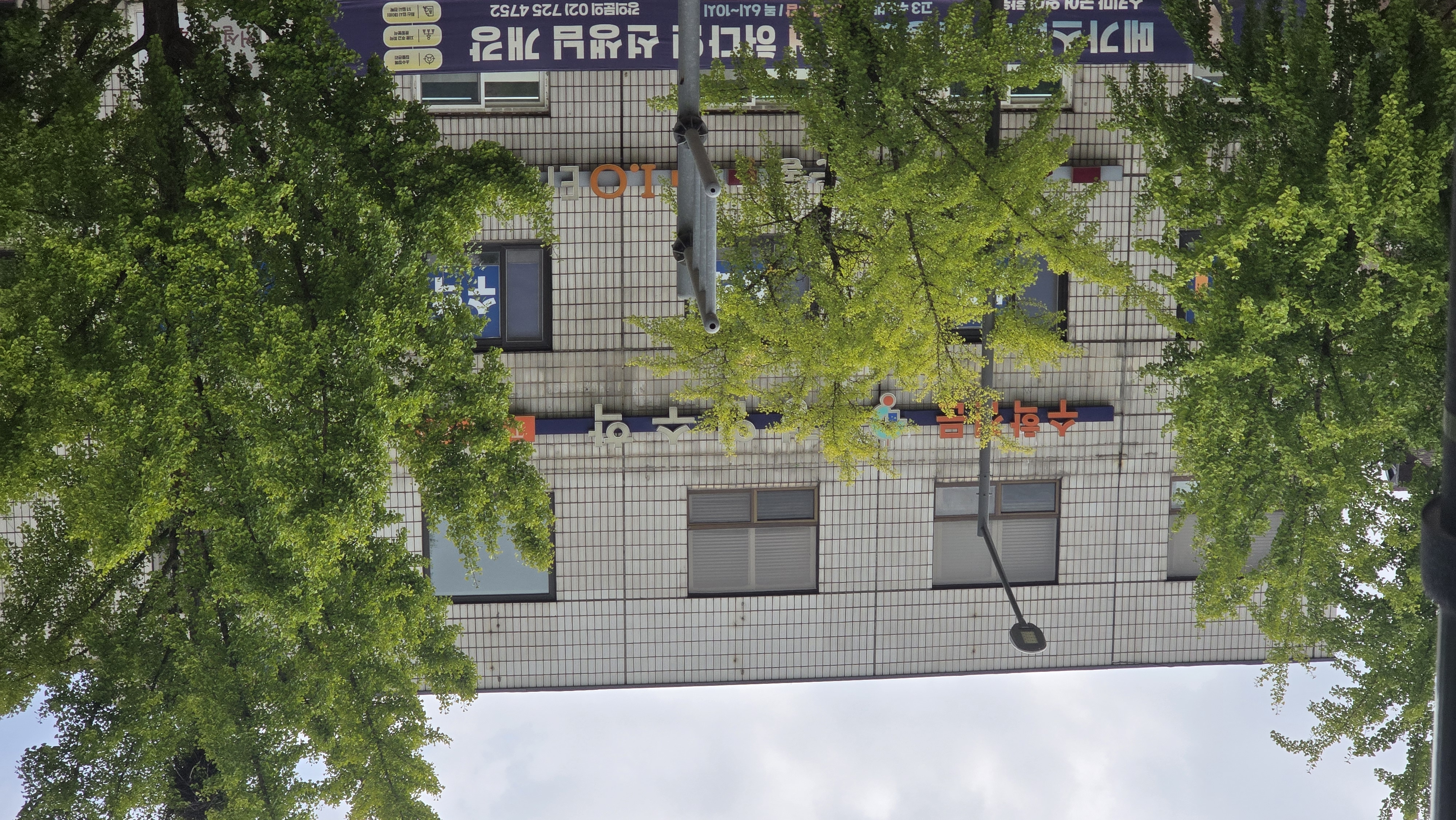
In South Korea, parents often say that English can be improved later, history can be memorized later, but mathematics cannot easily be recovered once a student falls behind.
That belief has helped create one of the most competitive private mathematics education markets in the world.
For students aiming at Seoul National University, Yonsei University, Korea University, leading engineering schools or medical programs, mathematics is frequently treated not simply as another school subject but as a gatekeeper subject.
But is mathematics really the subject that determines which university a Korean student can attend?
The answer is more nuanced than a simple yes or no.
There is no national admissions rule saying that mathematics is always the most important subject. Universities use different combinations of school records, the College Scholastic Ability Test, essays, interviews and other criteria.
However, particularly in competitive STEM-oriented admissions, mathematics often carries unusually high weight and has another important characteristic: the performance gap between students can become very large.
That combination gives mathematics considerable influence over admissions outcomes.
Korea Still Has a KRW 27.5 Trillion Private Education Market
The latest official government statistics show that Korean families spent approximately KRW 27.5 trillion on private education in 2025.
This was down from a record KRW 29.2 trillion in 2024, partly reflecting South Korea’s declining student population.
The number of elementary, middle and high school students fell from approximately 5.13 million in 2024 to 5.02 million in 2025.
Private education participation also declined from 80.0% to 75.7%.
But another number tells a different story.
Among students who actually participated in private education, average monthly spending increased from KRW 592,000 in 2024 to approximately KRW 604,000 in 2025.
| 2025 Korean Private Education Indicator | Result |
|---|---|
| Total private education spending | KRW 27.5 trillion |
| Total elementary-middle-high students | About 5.02 million |
| Private education participation rate | 75.7% |
| Average monthly spending, all students | KRW 458,000 |
| Average monthly spending, participating students | KRW 604,000 |
| Elementary private education spending | KRW 12.2 trillion |
| Middle school spending | KRW 7.6 trillion |
| High school spending | KRW 7.8 trillion |
This is extremely important for anyone examining education as a business.
Korea has fewer students, but families who remain active in private education are spending more per participating child.
The market is therefore not simply shrinking.
It is becoming more selective, competitive and premium-oriented.
Mathematics Alone May Represent a KRW 7–8 Trillion Market
Among students participating in subject-based private education in 2025, average monthly spending was approximately KRW 281,000 for English and KRW 270,000 for mathematics.
Across the entire student population — including students who did not take private math lessons — average mathematics spending was approximately KRW 128,000 per student per month.
Applying that figure to approximately 5.02 million elementary, middle and high school students implies an annual mathematics private-education economy of roughly KRW 7.7 trillion.
This should be viewed as a market-size approximation rather than a separate official government total, because mathematics education includes academies, tutoring, online education and other formats.
Nevertheless, it illustrates the extraordinary commercial importance of one academic subject.
Why Mathematics Becomes More Important as Students Get Older
The statistics also show how the economics change as students approach university entrance.
For participating students, average mathematics expenditure reached approximately KRW 312,000 per month for third-year middle school students and about KRW 399,000 for second-year high school students in 2025.
This pattern makes sense.
Elementary mathematics is largely about building basic numeracy and problem-solving habits.
Middle-school mathematics introduces algebraic thinking and increasingly abstract concepts.
High-school mathematics can become a highly competitive admissions subject involving Mathematics I and II, probability and statistics, calculus or geometry under the current CSAT structure.
Weakness accumulated in earlier years becomes increasingly difficult to repair.
Does Mathematics Really Decide Which University You Attend?
Not for every student and not for every university.
For humanities applicants, Korean language, mathematics, English, social studies and school records can all materially affect admission.
For holistic admissions, extracurricular academic activity and school performance can matter substantially.
But for regular CSAT-based admissions — particularly natural sciences and engineering — mathematics frequently receives one of the highest subject weightings.
For example, Hanyang University’s 2026 regular admissions formula for natural-science programs allocated 40% of the CSAT calculation to mathematics, compared with 25% for Korean, 25% for inquiry subjects and 10% for English.
Across major universities preparing for 2027 admissions, mathematics remains particularly important in many natural-science programs.
There is another reason mathematics matters.
Mathematics is highly differentiating.
In English, the CSAT uses an absolute grading system. Many strong applicants can therefore receive the same top grade.
Mathematics uses standardized scores that can create meaningful differences among high-performing students.
At the upper end of the admissions market, a relatively small mathematical performance gap can therefore move an applicant significantly within the ranking.
Mathematics Is a Gatekeeper, Not the Only Gate
The most accurate way to describe Korean university admissions is therefore:
Mathematics does not determine every university admission, but for many students targeting highly selective STEM, engineering and medical programs, it can be the subject with the greatest marginal impact.
A student with excellent English and social-studies scores but relatively weak mathematics may find many top science and engineering programs difficult to reach.
Conversely, a very strong mathematics score can significantly expand the number of competitive universities and majors available to a student.
This perception among parents creates powerful demand for mathematics education from elementary school onward.
Why Parents Start Math Education Early
Mathematics differs from many other school subjects because knowledge is cumulative.
A student who does not understand fractions may later struggle with algebra.
A student who struggles with algebra may have difficulty with functions.
Weak understanding of functions can eventually make calculus extremely difficult.
The commercial result is unusual.
Parents are not necessarily buying only this month’s mathematics lessons.
They are effectively buying protection against future academic failure.
This makes mathematics education particularly suitable for long-term enrollment.
Why Math Academies Are an Attractive Franchise Category
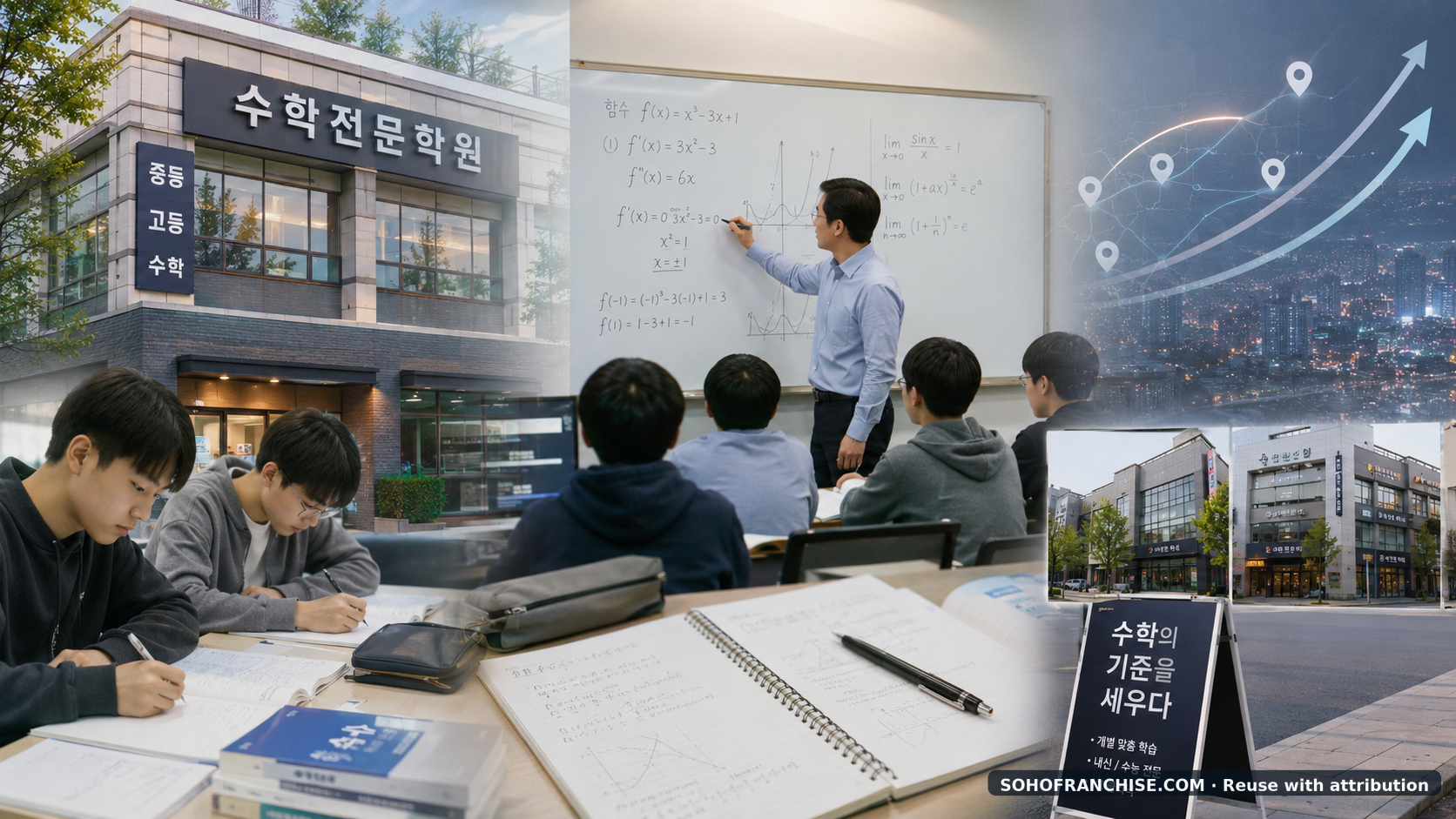
From a franchise perspective, mathematics has several characteristics that distinguish it from many other education businesses.
| Business Characteristic | Why It Matters |
|---|---|
| Recurring demand | Students typically attend for months or years rather than making a one-time purchase. |
| Clear performance measurement | School exams, mock tests and CSAT scores provide measurable outcomes. |
| Cumulative curriculum | Students can progress through standardized levels and courses. |
| High parental involvement | Parents actively monitor performance and are willing to pay for improvement. |
| Repeatable content | Problems, textbooks, tests and diagnostic systems can be centrally developed. |
| Digital compatibility | Homework, testing, video lessons and AI diagnostics can be delivered centrally. |
| Local delivery | Students still value nearby classrooms and teachers, supporting local franchise units. |
In theory, these characteristics make mathematics almost ideal for franchising.
A headquarters can develop the curriculum, textbooks, test database, learning-management system and teacher training while franchisees operate local classrooms.
But the Most Successful Math Academy Is Often Built Around a Teacher
This is also the biggest weakness in the franchise model.
A restaurant can standardize a recipe.
A convenience store can standardize inventory.
Education is harder to standardize because the teacher remains part of the product.
Parents frequently choose an academy not because of the sign above the door, but because of a particular instructor’s reputation.
This is especially true in highly competitive high-school mathematics.
A star instructor who consistently produces top scores can become more powerful locally than a national education brand.
That creates a fundamental challenge for franchising:
Can the franchise make the system more important than the individual teacher?
The Best Franchise Opportunity May Be Elementary and Middle School
The answer may depend on student age.
At the elite high-school level, success can depend heavily on exceptional instructors, advanced problem selection, university-specific admissions knowledge and local reputation.
This resembles a professional-services business more than a conventional franchise.
Elementary and middle-school mathematics may offer a more scalable model.
The curriculum is easier to standardize.
Diagnostic testing can place each student into a level.
Headquarters can provide standardized worksheets and examinations.
Teacher training can be systematized.
Progress can be reported to parents through an app.
And students can remain customers for several years.
This creates the possibility of high lifetime customer value.
AI Could Make Mathematics Academies Much More Franchiseable
Artificial intelligence may solve part of the traditional teacher-dependency problem.
AI does not necessarily need to replace the mathematics teacher.
Instead, it can standardize the information surrounding the teacher.
An AI-assisted math academy could continuously analyze:
- which concepts a student repeatedly gets wrong;
- how long each problem takes;
- which prerequisite concept is missing;
- which homework difficulty is appropriate;
- when review should be scheduled;
- how the student compares with similar learners;
- and whether performance is improving fast enough for a target university.
The teacher then focuses on explanation, motivation and difficult reasoning.
The headquarters controls curriculum, data and diagnostics.
The local franchise supplies human interaction and classroom management.
This combination could produce a much more scalable education franchise than the traditional “famous teacher plus classroom” model.
A Future Math Franchise Could Operate Like a Data Company
The most valuable asset of a future math-education franchise may not be its textbooks.
It may be its student-performance database.
Imagine a network with tens of thousands of students solving millions of mathematics problems every month.
The system could learn which errors predict later difficulty, which teaching sequences work best and which students are likely to fall behind before a traditional exam reveals the problem.
A local academy could then receive recommendations such as:
“This student has a high probability of struggling with calculus next year because of weaknesses in functions and algebra. Assign these 40 problems and schedule two concept-review sessions.”
That is much more difficult for an independent academy to build by itself.
And that is where a national franchise system can create genuine value.
Demographics Are the Biggest Business Risk
The Korean market also carries a major structural risk: fewer children.
The elementary, middle and high school population declined to around 5.02 million in 2025 and is expected to continue falling.
A franchise business that depends only on opening more classrooms cannot ignore this reality.
But the latest statistics reveal an interesting countertrend.
Total private-education expenditure fell in 2025, while average spending among participating students rose to a record level above KRW 600,000 per month.
That suggests the future market could have fewer customers but higher spending per serious customer.
For math academies, this favors strong brands, measurable outcomes, premium programs and sophisticated data systems over low-cost undifferentiated classrooms.
The Franchise Winner Will Sell a System, Not Just a Name
A successful mathematics franchise cannot simply provide a signboard and a textbook.
The headquarters needs to supply something an independent academy would have difficulty building alone.
That could include:
- a national mathematics curriculum;
- large-scale problem and examination databases;
- AI diagnostic testing;
- teacher certification and continuing training;
- student-level learning analytics;
- parent reporting systems;
- university admissions intelligence;
- digital homework and video content;
- local marketing support;
- and performance benchmarking across the franchise network.
If headquarters cannot provide these advantages, an experienced local teacher may have little reason to pay franchise fees or royalties.
SOHOFRANCHISE View: Mathematics Is Education Infrastructure
The Korean mathematics academy should not be viewed simply as another tutoring business.
It sits at the intersection of education, family expenditure, university competition, technology and social mobility.
Mathematics is not universally the single most important factor in Korean university admissions.
But for many of the country’s most competitive STEM, engineering and medical pathways, it remains one of the strongest academic gatekeepers.
That helps explain why Korean families continue investing heavily in mathematics even as the student population declines.
For franchise entrepreneurs, the opportunity is therefore substantial — but the traditional model needs to evolve.
The future math-academy franchise is unlikely to win simply by opening identical classrooms across Korea.
It will win by combining a strong local teacher with a nationally standardized curriculum, accumulated student data and AI-assisted personalized learning.
In that model, the local franchisee provides the human relationship.
The headquarters provides the educational operating system.
And mathematics — one of the most measurable and cumulative subjects in education — may be uniquely suited to that transformation.
Sources and methodology: Ministry of Education and Ministry of Data and Statistics, 2025 Private Education Expenditures Survey; 2026–2027 university admissions information and published university CSAT weighting systems. The estimated KRW 7.7 trillion mathematics segment is a SOHOFRANCHISE calculation based on official 2025 average monthly mathematics spending across the full student population multiplied by the national elementary, middle and high school student population, and should be interpreted as an approximate market indicator rather than an official standalone market total.