
More Than a Photo Machine
The first generation of automated photo booths was mainly about convenience.
Enter the booth, take a picture, print it and leave.
Today’s Korean self-photo stores are becoming something different.
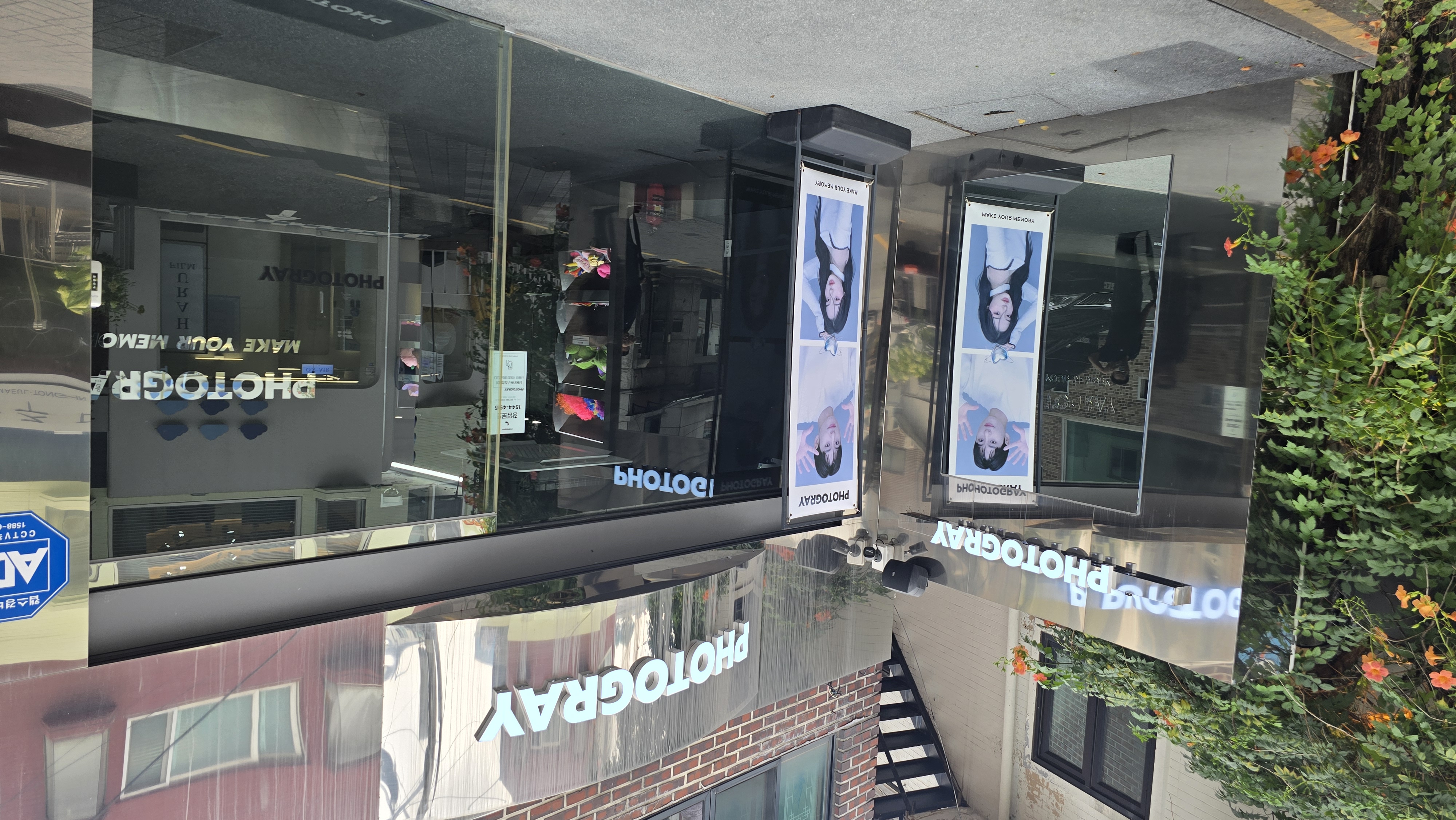
At the PHOTOGRAY location photographed by SOHOFRANCHISE, the storefront itself feels like part of the product. Large metallic signage, reflective surfaces and digital portrait displays immediately tell pedestrians what the business offers.
Even before entering, customers are exposed to the brand and the visual style of the experience.
That matters in a business where spontaneous walk-in traffic can be extremely important.
The Storefront Works Like Advertising
An unmanned store has fewer opportunities for an employee to invite a customer inside.
The storefront therefore has to perform that job.
PHOTOGRAY uses oversized branding and portrait imagery that can be understood quickly from the street.
For pedestrians, there is little need to ask what the business does.
The product is visible.
The customer can see the type of photographs available, recognize the entertainment value and make a purchasing decision within seconds.
For a compact retail business, this type of visual communication can be more valuable than having a large conventional sales floor.
From Photography to Entertainment Retail
Self-photo studios should not be viewed only as photography businesses.
They increasingly operate at the intersection of:
photography, entertainment, social media, fashion, tourism and souvenirs.
Customers are not simply paying for a printed photograph.
They are paying for several minutes of experience.
They can select a style, use props, pose together, produce a physical print and then share the image digitally.
This gives the business an emotional dimension that many other automated retail formats do not have.
Props Increase the Experience Without Adding Staff
Another visible feature of Korean photo-booth stores is the use of accessories and props.
Headwear, character items and decorative accessories allow customers to create different photos during the same visit.
These items appear simple, but they perform an important retail function.
They create variety.
A customer can return with a different friend, choose different accessories and create a completely different result.
This can help turn a one-time transaction into a repeatable leisure activity.
And because customers select the props themselves, the experience can remain largely self-service.
A Business Designed for the Smartphone Generation
The success of this format is closely connected to how younger consumers use images.
Photography is no longer reserved for major events.
People photograph meals, cafés, streets, travel experiences and everyday meetings with friends.
The photo booth takes this digital behavior and adds something physical.
The customer leaves with a printed item that can be carried, displayed, collected or given to someone else.
For tourists, it can also become a small souvenir from Seoul.
That combination of physical and digital value is one reason the category fits naturally into modern lifestyle districts.
Small Space, Strong Brand
From a franchise perspective, one of the most interesting characteristics of this model is the relationship between store size and brand visibility.
The business does not necessarily require a large conventional retail footprint.
Instead, value can come from:
location + visual branding + automated equipment + repeatable customer experience.
A small store in a strong pedestrian location can potentially generate far more attention than its physical size would suggest.
This is increasingly important in cities where commercial rents are high and operators are looking for formats that can generate sales from smaller spaces.
Unmanned Does Not Mean Unmanaged
The apparent simplicity of the store can also be misleading.
Behind an unmanned photo business are still important operational requirements.
Camera and printer reliability matter.
Lighting must remain consistent.
Consumables need replenishment.
Props and interiors need cleaning.
Payment systems must work continuously.
Software and digital content need maintenance.
Customer problems still require a support process.
The business therefore does not eliminate operations.
It changes where those operations take place.
Instead of having employees permanently positioned behind a counter, more work can be centralized into equipment management, remote support and periodic store maintenance.
Seoul as a Laboratory for Micro-Retail
The streets of Seoul increasingly show how small-format retail may evolve in other high-density cities.
Unmanned fashion shops, laundries, convenience concepts and photo studios are experimenting with different combinations of automation and physical experience.
Self-photo stores are especially interesting because they demonstrate that automation does not have to make retail emotionally cold.
In this case, the technology operates quietly in the background while the customer creates something personal.
That may be an important lesson for the next generation of unmanned businesses.
Field Intelligence
The PHOTOGRAY storefront photographed in Seoul suggests that the competitive advantage of an unmanned photo business is moving beyond the photo machine itself.
The stronger model combines:
recognizable branding + high-visibility storefront + simple self-service + props + social-media-friendly output + a memorable physical souvenir.
For franchise operators, the opportunity may therefore be less about selling photography equipment and more about building a repeatable lifestyle experience around that equipment.
As Seoul continues to attract both domestic consumers and international visitors, these small-format photo businesses may become an increasingly visible part of the city’s tourism and micro-retail landscape.
SOHOFRANCHISE will continue documenting these businesses directly from the streets to understand how unmanned retail is developing in real operating environments.