

A parking lot is one of the simplest businesses to understand.
A car enters, occupies space for a certain period of time, pays a fee and leaves.
For decades, the business depended primarily on three things: location, land value and traffic.
But that model is beginning to change.
License-plate recognition, mobile payment, AI cameras, cloud-based pricing, EV charging and autonomous driving are gradually turning parking lots from passive pieces of real estate into technology-operated service businesses.
This raises an interesting franchise question:
Could the parking lot become one of the next large-scale unmanned franchise businesses?
Korea Has Already Moved Deep Into Unmanned Parking
Anyone driving through Seoul can see the transformation.
Small surface parking lots, apartment garages, hospitals, commercial buildings and public parking facilities increasingly operate without a permanent cashier.
Cars are identified automatically by license-plate cameras.
Parking time is calculated by software.
Payment is made through cards, mobile applications or pre-registered vehicle accounts.
Remote control centers can handle problems that once required an employee at every location.
This is an important business change.
Parking is becoming less labor-intensive and more software-intensive.
The Large Operators Are Becoming Technology Companies
Korea already has several large parking platforms demonstrating how far the model can scale.
HiParking, part of Humax Mobility, operates roughly 1,400 locations and around 290,000 parking spaces nationwide.
The company says approximately 25 million vehicles pass through its systems each month.
Rather than viewing itself simply as a parking-lot operator, it is developing AI-based systems for space utilization, pricing, traffic guidance, vehicle data and mobility services.
NHN’s iParking has developed an even broader network, reporting approximately 10,000 parking sites nationwide.
In 2026, iParking completed testing of an AI-based unmanned on-street parking system with Gangnam-gu in Seoul.
The significance of that project is important.
Traditional unmanned parking works best when there is a gate.
AI vision systems can potentially identify whether a vehicle has actually parked even when there is no barrier at all.
That expands automation into street parking, small urban lots and public parking areas that were previously difficult to operate without staff.
Parking Is Already Becoming a Platform Business
The consumer side is changing as well.
Online parking platform Modu Parking reported more than 5.5 million registered users and parking-ticket transaction value exceeding KRW 60 billion during 2025.
That means customers increasingly do not discover parking simply by seeing a sign while driving.
They search for it.
They compare prices.
They reserve spaces.
They pay before arriving.
This is similar to what happened to hotels, taxis and food delivery.
Physical inventory is increasingly connected to a digital platform.
But Is Parking Really a Franchise Business?
Not in the traditional sense.
A hamburger franchise can provide the same menu, equipment and store design to hundreds of operators.
Parking is fundamentally tied to real estate.
Every location has different land costs, access roads, traffic patterns, local regulations and demand.
Therefore, the most realistic model is not a classic franchise.
It is closer to a combination of:
- franchise;
- management contract;
- technology licensing;
- revenue sharing;
- equipment leasing;
- and property-operation outsourcing.
A small property owner could provide the land.
The parking brand could provide the equipment, software, payment platform, pricing system, customer application and remote operation center.
Revenue could then be divided according to contract.
The Franchise Headquarters Does Not Need to Own the Land
This is the most interesting part of the model.
A future parking network does not necessarily need to purchase hundreds of expensive urban properties.
Instead, it can connect underutilized land owned by others.
Possible locations include:
- empty commercial lots;
- church parking areas during weekdays;
- office parking at night;
- school or academy parking during unused hours;
- hotel parking;
- apartment visitor spaces;
- hospital parking;
- shopping-center parking;
- unused industrial land;
- and redevelopment sites awaiting construction.
The headquarters effectively turns fragmented parking inventory into a recognizable network.
AI Changes the Economics
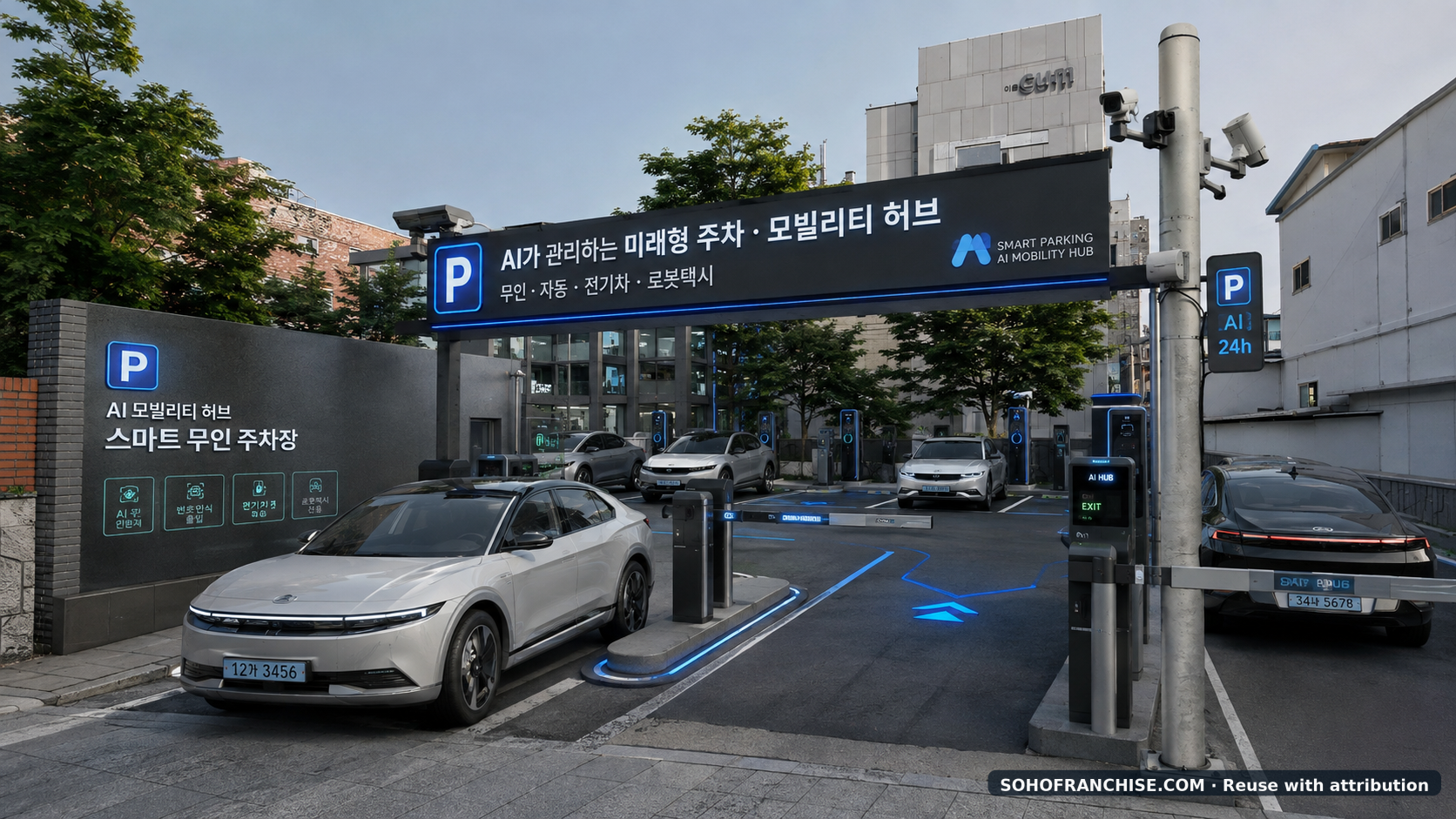
The biggest cost of a small parking business used to be human operation.
An employee had to collect money, verify vehicles, resolve disputes and sometimes guide traffic.
AI and cloud systems can now perform much of this work.
| Traditional Parking Lot | AI Parking Network |
|---|---|
| On-site cashier | Automated payment |
| Manual vehicle identification | AI license-plate recognition |
| Fixed pricing | Demand-based pricing |
| Local operation | Central remote control |
| Driver searches for parking | App reservation and navigation |
| Parking revenue only | Parking + charging + mobility services |
Once hundreds of locations are connected, AI can analyze utilization by hour, day, event and neighborhood.
A parking lot that is 95% full every weekday morning may need a higher price.
A lot that is empty every Sunday may need discounts or partnerships with nearby restaurants.
The headquarters can make these decisions across an entire network.
And Then Autonomous Cars Arrive
This is where the parking business becomes much more interesting.
Seoul is already operating autonomous taxi services.
In August 2026, Seoul expanded its late-night autonomous taxi fleet in Gangnam from seven vehicles to 19 after continuing demand.
This is still a very small fleet.
But imagine Seoul ten years from now with thousands — or tens of thousands — of autonomous taxis, delivery vehicles and shared vehicles.
Those vehicles will still need physical space.
They need somewhere to wait between customers.
They need electricity.
They need cleaning.
They need inspection.
They occasionally need maintenance.
And they need places where software systems can safely manage large vehicle fleets.
The Parking Lot May Become the Robotaxi’s Hotel
A human taxi driver can drive home after work.
A robotaxi cannot.
An autonomous fleet needs infrastructure.
A future parking facility could provide:
- AI-controlled vehicle staging;
- fast EV charging;
- automatic car washing;
- battery diagnostics;
- tire inspection;
- vehicle cleaning;
- minor robotic maintenance;
- software updates;
- fleet dispatch;
- and overnight storage.
In that world, calling the facility a “parking lot” may no longer be accurate.
It becomes a mobility service station for robots.
Autonomous Cars Could Also Reduce Traditional Parking Demand
There is an important counterargument.
If autonomous taxis become cheap and convenient, some urban residents may stop owning cars.
One shared autonomous vehicle could serve many passengers during the day instead of remaining parked for more than 20 hours.
That could eventually reduce demand for expensive parking spaces attached to apartments and offices.
So autonomous vehicles may destroy part of the traditional parking business.
But they may simultaneously create an entirely new parking market.
The location of demand changes.
Instead of every office worker requiring a parking space directly underneath an office building, autonomous fleets may require large strategically positioned hubs near dense transportation zones.
Location Will Still Be Everything — But for a Different Reason
Today, parking value depends heavily on where human drivers want to stop.
Tomorrow, parking value may depend on where AI-controlled vehicles need to wait.
A robotaxi may not care whether a parking garage has marble walls or convenient elevators.
It may care about:
- distance from anticipated passenger demand;
- charging speed;
- electricity price;
- network connectivity;
- traffic congestion;
- access at all hours;
- and automated entry and exit.
This changes the economics of previously unattractive land.
A site that is inconvenient for a human customer might be perfectly suitable for an autonomous fleet.
EV Charging Could Become the Second Revenue Stream
Parking and EV charging naturally fit together.
The customer is already paying to leave a vehicle in one place for a period of time.
Adding electricity turns unused parking time into another transaction.
For autonomous fleets, charging can be automatically scheduled according to electricity prices, battery state and predicted transportation demand.
A parking operator could therefore earn from both space and energy.
Other Revenue Streams Could Follow
A mature mobility hub could eventually make money from several activities.
| Revenue Source | Possible Customer |
|---|---|
| Parking fees | Private drivers |
| Monthly subscriptions | Residents and office workers |
| EV charging | Private EVs and fleets |
| Robotaxi staging | Mobility platforms |
| Fleet charging contracts | Taxi and delivery operators |
| Automated washing | Private and fleet vehicles |
| Advertising | Local businesses |
| Reservation commissions | Drivers |
| Vehicle-data services | Mobility operators |
What Would a Parking Franchise Actually Sell?
The headquarters would not simply sell a brand name.
It would need to provide a complete operating system.
A credible parking franchise platform could include:
- AI cameras and license-plate recognition;
- payment terminals;
- cloud parking software;
- mobile reservation;
- dynamic pricing;
- remote customer service;
- EV charger integration;
- maintenance;
- insurance and incident management;
- accounting;
- local marketing;
- and fleet partnerships.
This creates a very different franchise relationship from a restaurant.
The property owner provides the location.
The parking platform provides the technology and customers.
The strongest operator may eventually provide the autonomous vehicles as well.
Could Small Investors Participate?
Potentially, yes.
A small operator does not necessarily need to own a major downtown garage.
A relatively small urban lot could become part of a larger digital network.
The key is utilization.
A 20-space parking lot operating at high occupancy with low labor cost can be economically more attractive than a larger facility with poor traffic.
But investors must be careful.
Parking is highly dependent on lease costs and local demand.
An attractive unmanned system cannot rescue an expensive lease in a location where nobody wants to park.
The Biggest Franchise Opportunity May Be Operations, Not Real Estate
This distinction is crucial.
SOHOFRANCHISE does not believe the most scalable business is simply buying parking lots.
The scalable opportunity is operating other people’s parking lots better.
That means turning thousands of separately owned spaces into a standardized network.
Hotels did this through booking platforms.
Restaurants did it through delivery platforms.
Parking could follow a similar path.
SOHOFRANCHISE View: From Parking Space to Mobility Node
The parking business is unlikely to disappear.
But its purpose may change dramatically.
Today, a parking lot primarily stores privately owned cars.
Tomorrow, it may store, charge and service autonomous machines that continuously move people and goods around a city.
That creates an unusual opportunity for franchise entrepreneurs.
The future parking franchise may not really be a parking franchise at all.
It could be a distributed network of small mobility hubs linked by AI.
The headquarters controls the software, pricing, data, reservations and fleet relationships.
Local partners provide physical locations.
Autonomous vehicles provide the traffic.
And what looks today like an ordinary parking lot could become one of the most important pieces of urban infrastructure in the AI mobility economy.
Sources and reference framework: Seoul Metropolitan Government autonomous taxi program; HiParking/Humax Mobility parking operations and AI mobility-hub strategy; NHN iParking AI unattended parking systems; Modu Parking/Socar platform statistics; Hyundai Motor Group autonomous parking and parking-robot development. Market figures in this article describe reported company operations and industry developments rather than guarantees of investment returns.