
SOHOFRANCHISE Field Intelligence · Seoul, Korea · August 2026
A self-laundry may not look like the newest form of retail technology, but it is one of the clearest examples of how a traditional service can be redesigned for unmanned operation.
At this WashQ self-laundry in Seoul, customers can enter the store, choose a washer or dryer, make payment and complete the entire laundry process without a conventional service counter.
The business is built around equipment, simple instructions and self-service infrastructure rather than employees standing in the store.
The machines are the core of the business
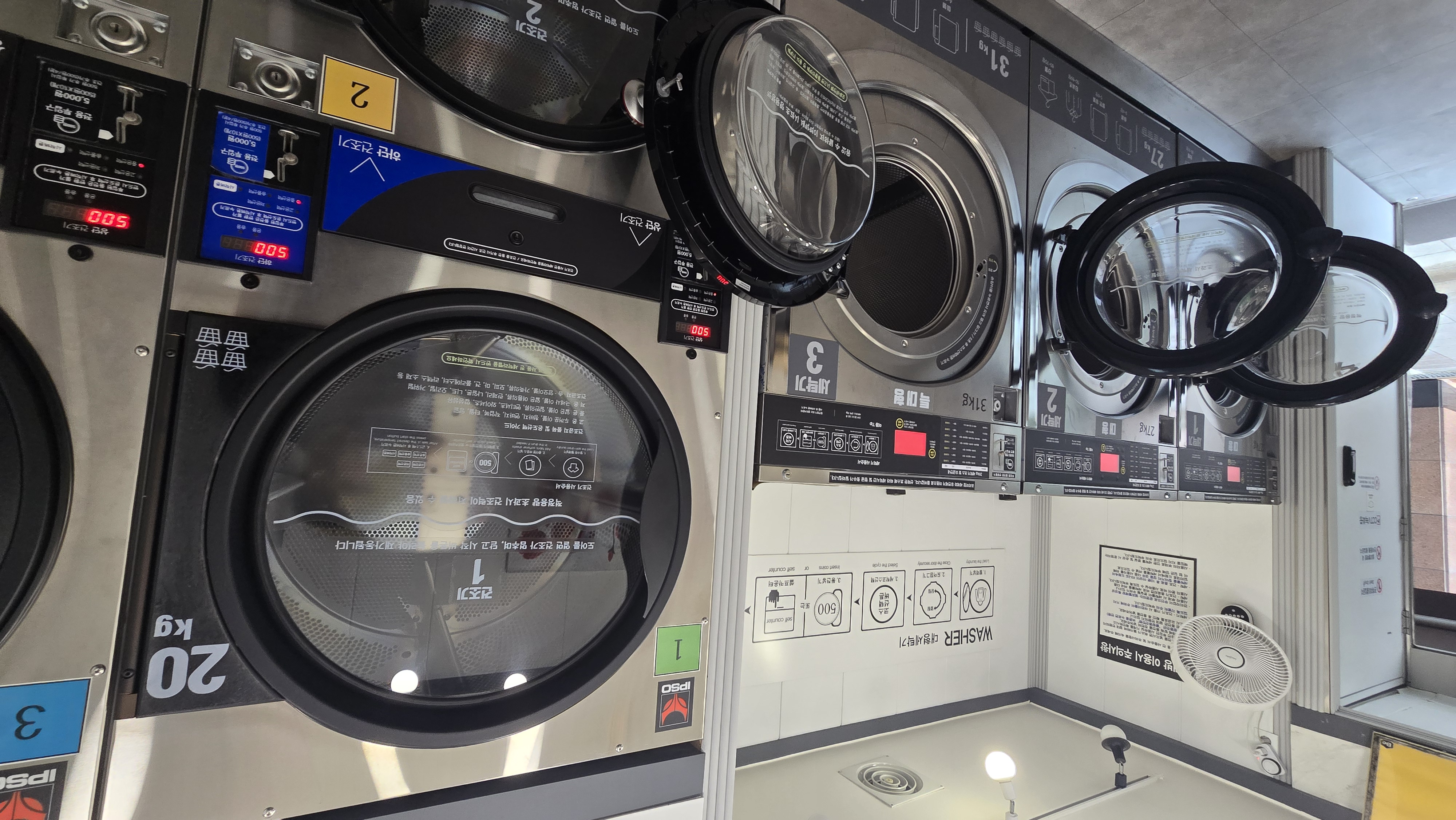
Large-capacity washers and dryers occupy most of the space. The machines photographed at the location include units designed for relatively large laundry loads, making the store useful not only for everyday clothing but also for bulky items that may be inconvenient to wash at home.
For an unmanned laundry, machine availability is essentially the store’s production capacity.
A machine that is out of service is similar to a closed table in a restaurant: the store can still operate, but revenue capacity immediately falls.
Payment has to work without assistance
The store uses a self-counter and coin-based payment infrastructure so customers can operate the equipment without an employee.
A separate coin exchange machine is installed, and the self-counter also provides a card-payment interface.
The photographed interface includes both Korean and English instructions, which can be particularly useful in areas with foreign residents or visitors.
This is an important part of unmanned retail.
When there is no employee nearby, the interface itself has to become the salesperson, cashier and instructor.
Even the small necessities are automated
The store also has a vending system for items customers may need during washing and drying, including laundry bags and dryer-related consumables.
This may look like a small detail, but it solves an important problem.
A customer who forgets something does not have to leave the store or call an employee. The business can complete more of the customer journey inside the same space.
Unmanned does not mean unmanaged
The location also displays CCTV monitoring and operating instructions.
That reveals one of the most important realities of unmanned businesses:
Removing the cashier does not remove operational work.
Someone still has to clean the store, inspect machines, replenish consumables, respond to breakdowns and handle customer problems.
The real economic advantage therefore comes not from eliminating people completely, but from reducing the amount of time an employee must remain physically inside one location.
One operator may potentially manage several locations if maintenance, monitoring and customer support are organized efficiently.
Why self-laundry fits the unmanned model
Laundry has several characteristics that make it particularly suitable for self-service operation.
The customer already understands the basic process. The service is standardized. Payment happens before or during use. And the physical work is performed by machines rather than employees.
That is very different from businesses where customers require continuous consultation or personal service.
For this reason, the self-laundry model demonstrates an important principle for future unmanned businesses:
The easiest businesses to automate are often the ones where the customer already knows exactly what they came to do.
SOHOFRANCHISE View
The interesting part of this store is not simply that there is no cashier.
It is that almost every function normally performed by an employee has been converted into a physical or digital system:
washing → machines
drying → machines
payment → self-counter
cash conversion → coin exchanger
consumables → vending machine
security → CCTV
instructions → signage and touchscreen
That is what a practical unmanned business looks like.
As AI and remote monitoring technology improve, these stores may become even easier to manage from outside the location. But the fundamental business model is already here: machines perform the service while people manage the system.
Observed and photographed by SOHOFRANCHISE in Seoul, Korea.