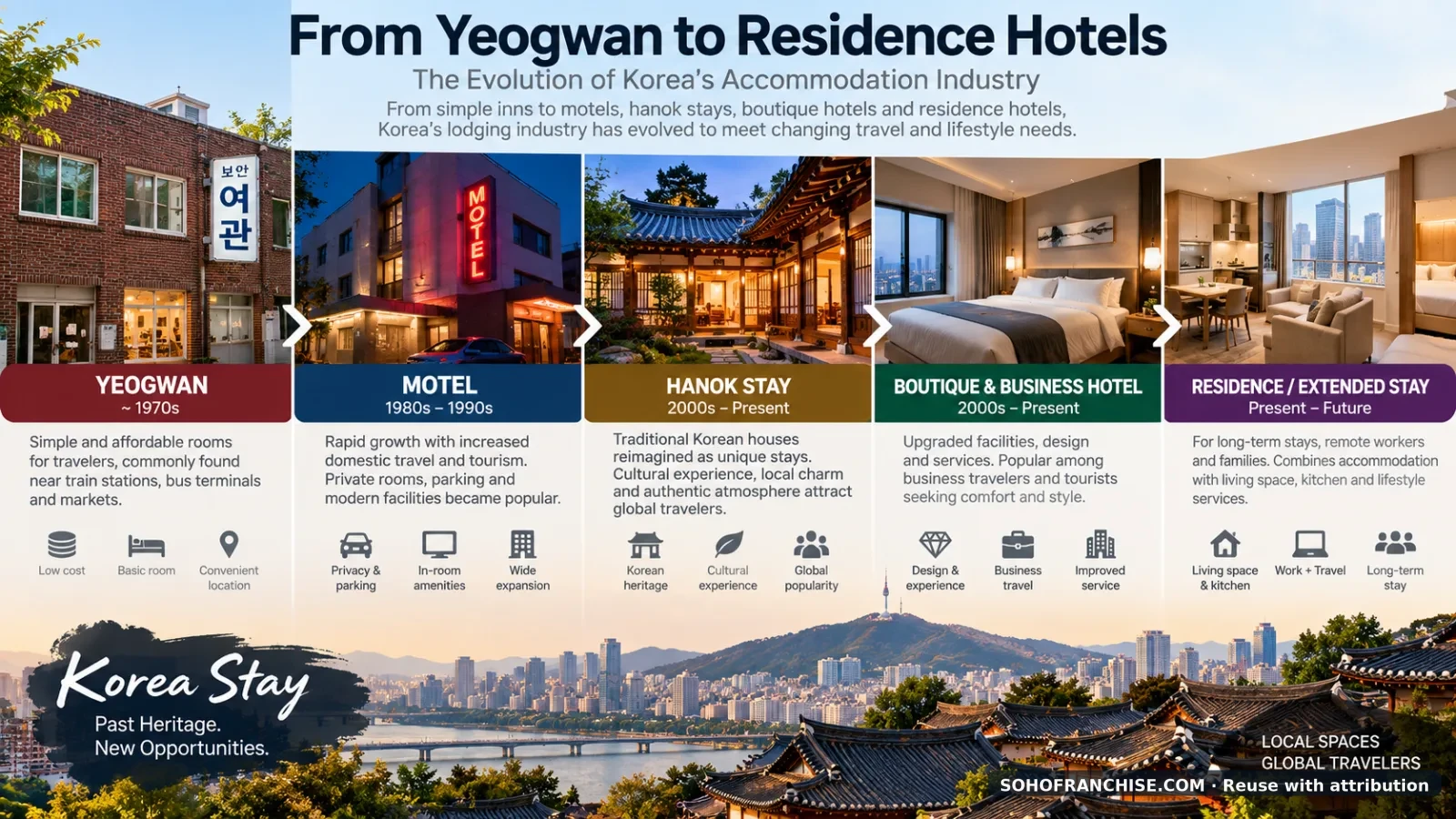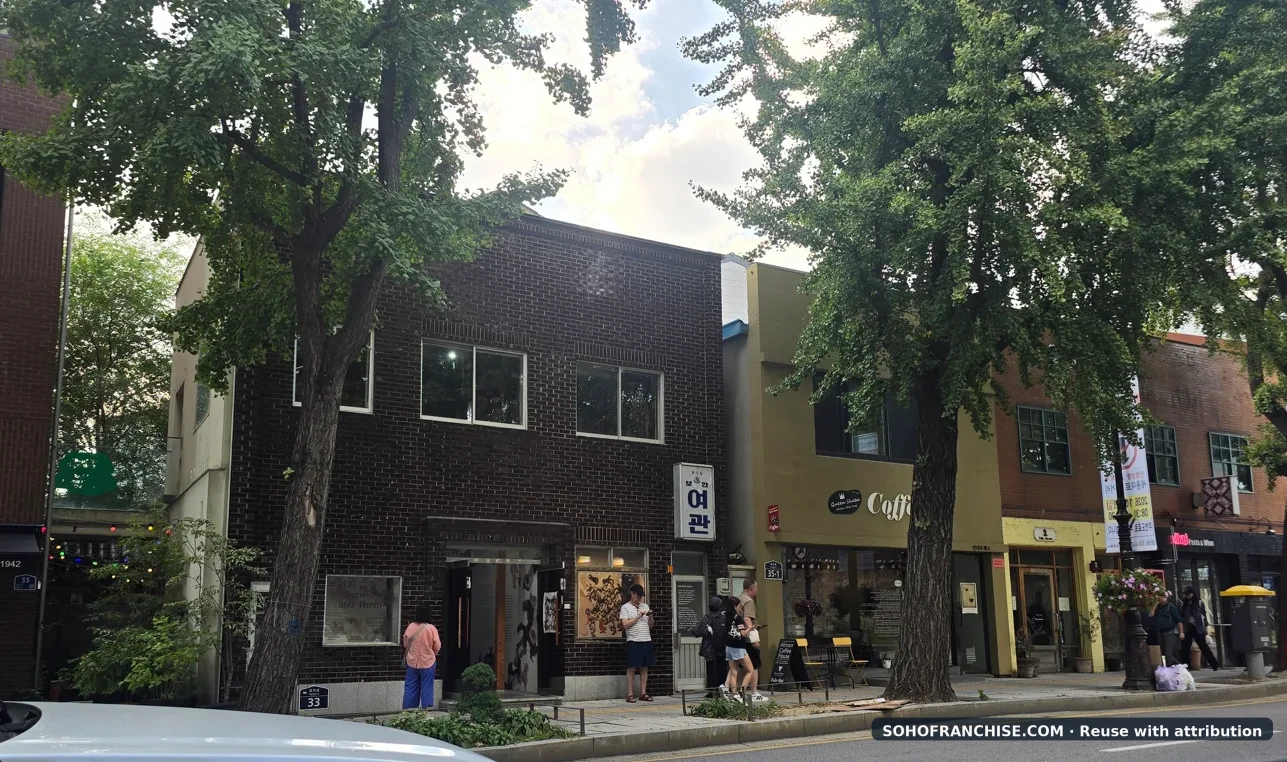
Korea's lodging industry has changed dramatically over the past several decades.
What once began with the humble yeogwan (여관) — a simple and inexpensive place for travelers to sleep — gradually expanded into motels, tourist hotels, business hotels, boutique hotels, residences and a growing variety of alternative accommodations.
But perhaps the yeogwan should not simply disappear.
As international travelers increasingly search for local experiences rather than standardized hotel rooms, an interesting question emerges:
Could “Yeogwan” itself become a modern Korean hospitality brand?
From a Cheap Room to a Korean Travel Experience
For decades, yeogwan were among Korea's most accessible accommodations. They could be found near railway stations, bus terminals, traditional markets and commercial districts throughout the country.
The proposition was straightforward: a relatively inexpensive room, basic facilities and a convenient location.
As Korea industrialized and domestic travel increased, the lodging market evolved. Motels expanded rapidly, followed by business hotels and more sophisticated accommodation concepts.
Many older properties subsequently renovated their rooms and replaced the word “Motel” with names such as Hotel, Boutique Hotel, Stay or Residence.
The physical product was still fundamentally a room, but the way that room was positioned and sold had changed.
Seoul Is Rediscovering Small-Scale Accommodation
Another transformation is now taking place, particularly in Seoul's older neighborhoods north of the Han River.
Areas around Jongno, Bukchon and other historic districts contain something that newly developed hotel districts cannot easily reproduce: narrow streets, traditional architecture, small independent buildings and direct access to the everyday texture of Seoul.
Hanok stays have turned some of these characteristics into an accommodation product. Instead of competing with large hotels on room size, restaurants or extensive facilities, they compete through place, architecture, history and experience.
The Seoul Metropolitan Government already recognizes urban homestays and hanok stays as alternative accommodation capable of responding flexibly to changing tourism demand.
Its Seoul Stay program supports legally registered urban homestays and hanok experience accommodations, positioning them as ways for visitors to experience Seoul's local culture rather than simply finding somewhere to sleep.
Hanok Stay Shows What Rebranding Can Do
The rise of the hanok stay provides an interesting business lesson.
A traditional house was once primarily valued as residential property. Today, the same architectural characteristics — wooden structures, courtyards, traditional doors, ondol rooms and compact spaces — can become part of a premium travel experience.
In other words, what once appeared old can acquire new economic value when its history becomes part of the product.
The same question can therefore be asked about Korea's remaining yeogwan.
What If We Keep the Name “Yeogwan”?
Renovating an old yeogwan does not necessarily mean turning it into another generic hotel.
Imagine instead retaining the Korean word:
YEOGWAN
Korean Urban Stay
Small Rooms · Local Neighborhood · Korean Design · Affordable Stay
The rooms could be modernized while preserving selected elements of the original building. Traditional typography, Korean materials, old photographs and neighborhood stories could become part of the identity.
Bathrooms, bedding, Wi-Fi, security and cleanliness would meet contemporary expectations, while the property's history would differentiate it from standardized budget hotels.
Rather than hiding the building's past, the business could make that past the brand.
Airbnb Changed How Small Properties Reach Global Travelers
Digital accommodation platforms have also changed the economics of small lodging businesses.
Historically, an independent inn depended heavily on walk-in customers, roadside signage and local travel guides. Today, online platforms allow a small property in a Seoul neighborhood to become visible to travelers around the world.
Airbnb is perhaps the best-known example of this change, but the broader transformation goes beyond any single platform.
Photography, reviews, digital reservations, multilingual descriptions and online maps have dramatically reduced the marketing disadvantage once faced by small independent accommodation businesses.
A five-room property can now present its story internationally without operating a global hotel brand.
Airbnb Is a Platform — Not a Business License
There is, however, an important distinction for anyone considering the business opportunity.
Listing a property on an accommodation platform does not by itself determine whether that property can legally operate as tourist accommodation.
Korea has different regulatory categories for accommodation businesses, including tourism accommodation, foreign-tourist urban homestays and hanok experience businesses. Registration requirements, eligible buildings, permitted guests and operating conditions can differ according to the business category and location.
For example, Korea's Tourism Promotion Act framework defines foreign-tourist urban homestays as qualifying urban residents providing accommodation in the home in which they reside so that foreign tourists can experience Korean home culture. Hanok experience businesses are separately defined for accommodation and cultural experiences using qualifying traditional Korean houses.
For entrepreneurs, therefore, the first question should not simply be, “Can I put this property on Airbnb?” but rather:
Under which accommodation category can this property legally operate?
The Lodging Market Is Becoming More Segmented
The evolution of Korean accommodation can be viewed as a continuing expansion of what travelers are actually buying.
| Format | Traditional Value | Modern Opportunity |
|---|---|---|
| Yeogwan | Affordable room | Korean urban heritage stay |
| Motel | Convenience & privacy | Boutique / design hotel |
| Hanok | Traditional residence | Cultural experience stay |
| Urban Home | Residential space | Urban homestay |
| Residence | Long-term accommodation | Work + travel + extended stay |
Gangbuk Could Be Particularly Interesting
Seoul's accommodation market does not necessarily have to develop only through large new hotels.
The northern part of central Seoul contains a considerable stock of older buildings and neighborhoods close to palaces, traditional markets, universities, cultural districts and public transportation.
Bukchon demonstrates how traditional architecture can itself become a tourism asset. Other neighborhoods may offer different stories: post-war Seoul, old commercial streets, market districts or the small inns that once accommodated domestic travelers.
This creates an opportunity for many different forms of small-scale hospitality rather than one standardized hotel model.
From “Old” to “Authentic”
There is an important entrepreneurial distinction between an old building and a heritage product.
An old building with poor facilities is simply inconvenient.
But an older property with excellent cleanliness, comfortable bedding, modern bathrooms, good digital services and a carefully preserved story can become something completely different.
Age alone has little value. Authenticity combined with modern hospitality can.
From Selling a Bed to Selling Seoul
The Korean lodging industry has already moved through several generations:
YEOGWAN → MOTEL → BOUTIQUE HOTEL → BUSINESS HOTEL → RESIDENCE
But the next stage does not necessarily have to continue moving in the same direction.
Some entrepreneurs may move backward in time — intentionally.
A renovated hanok can become a premium stay. An ordinary Seoul home can become an urban homestay. And perhaps an old yeogwan can become a new kind of Korean urban accommodation.
The opportunity may lie not in removing the word “Yeogwan”, but in giving it a new meaning.
For Korea's small hospitality entrepreneurs, that could represent an interesting shift:
Don't just sell a cheaper room. Sell a place, a neighborhood and a Korean story.