
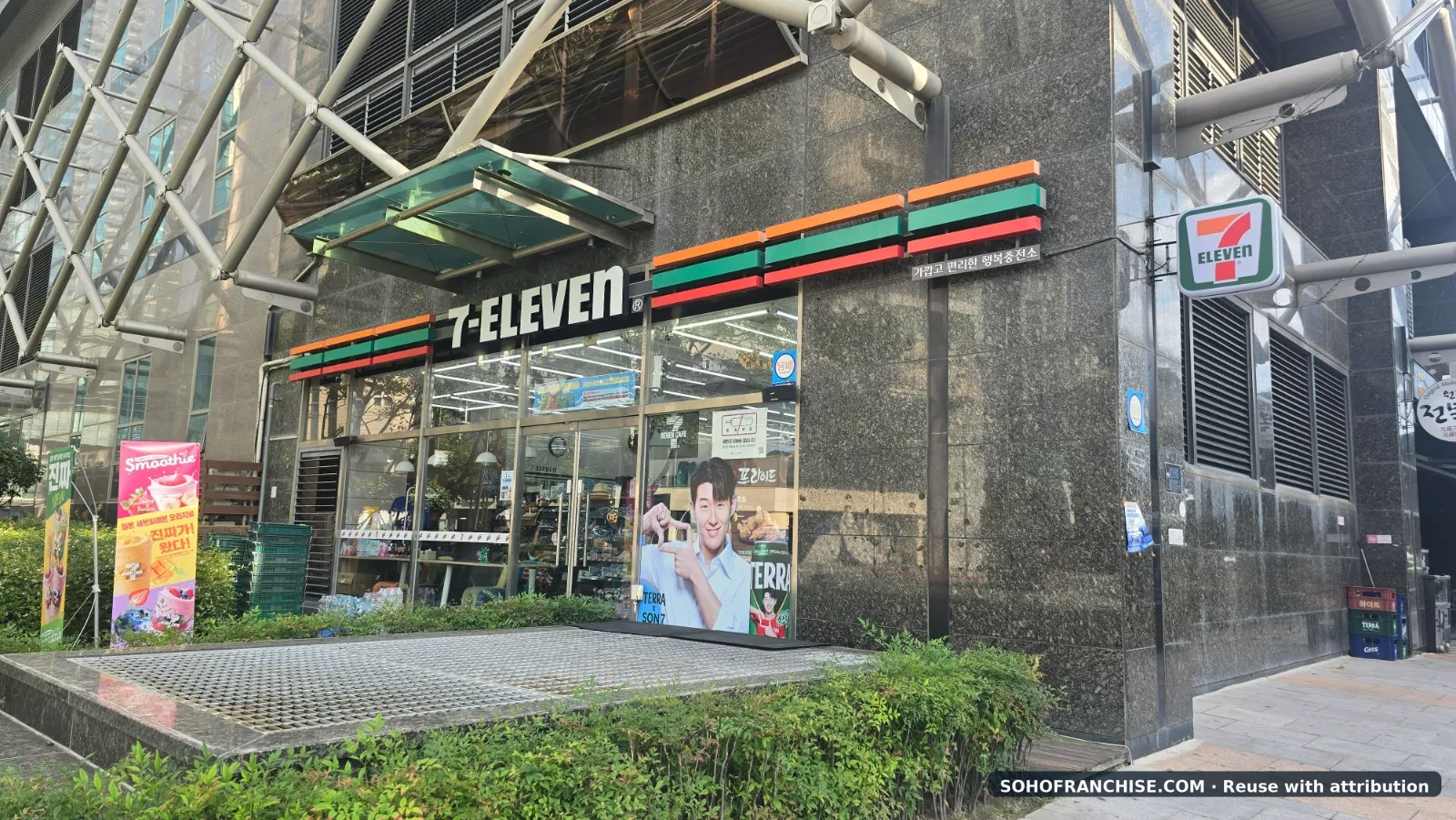
South Korea may be one of the most competitive grocery retail markets in the world. Within a short walk in Seoul or most Korean cities, consumers can often choose between several convenience stores, a neighborhood supermarket, an independent grocery shop and, increasingly, a corporate-branded supermarket offering fresh food and rapid delivery.
For entrepreneurs, however, these stores represent very different business models. A CU or GS25 franchise provides a brand, national procurement system and sophisticated logistics. An independent supermarket gives the owner far greater freedom, but also places purchasing, merchandising, pricing and inventory risk directly on the operator.
Korea's Convenience Store Network
At the end of 2025, the four major convenience-store operators had approximately 53,266 stores nationwide. After decades of almost uninterrupted expansion, the number declined as operators began closing weaker locations and concentrating on profitability rather than simply increasing store numbers.
| Brand | Approx. Stores at End-2025 | Market Position |
|---|---|---|
| CU | 18,711 | Largest network |
| GS25 | 18,005 | Strong No. 2 / leading sales scale |
| 7-Eleven | 11,040 | Restructuring after Ministop integration |
| Emart24 | 5,510 | Smaller network, efficiency-focused |
| Total | 53,266 | Four major chains |
The decline may not mean that the convenience-store business is disappearing. By July 2026, the combined network had recovered slightly to about 53,458 stores. The important change is that the industry is moving from store-count competition to store-quality competition.
Operators are increasingly experimenting with larger stores, fresh-food sections, desserts, health products, ready-to-eat meals and delivery. Convenience stores are gradually becoming small neighborhood food platforms rather than simply places to buy drinks, cigarettes and snacks.
Average Sales Show the Power of the Major Brands
Franchise disclosure data also illustrates the scale difference among the four major operators. Reported annual average sales per franchise store were approximately:
| Brand | Average Annual Franchise Sales | Approx. Monthly Sales |
|---|---|---|
| GS25 | KRW 644 million | KRW 53.7 million |
| CU | KRW 634 million | KRW 52.8 million |
| 7-Eleven | KRW 511 million | KRW 42.6 million |
| Emart24 | KRW 451 million | KRW 37.6 million |
These figures are sales, not the owner's income. Rent, labor, electricity, product losses, franchise profit-sharing arrangements and the owner's own working hours can dramatically change actual profitability.
This distinction is particularly important for retirees looking at convenience stores as a post-retirement business. A store generating KRW 50 million per month in revenue does not automatically provide a high personal income.
Corporate Supermarkets: The SSM Market
Between the convenience store and the large hypermarket is Korea's corporate supermarket sector, commonly known as SSM, or Super Supermarket.
The major operators now have roughly 1,450 stores nationwide. The latest reported figures show a particularly strong expansion by GS The Fresh.
| Corporate Supermarket Brand | Latest Reported Store Network | Recent Direction |
|---|---|---|
| GS The Fresh | 589 | Expanding, especially through franchises |
| Lotte Super | About 331 | Selective restructuring |
| Homeplus Express | 293 | Network restructuring / ownership transition |
| Emart Everyday | About 241 | Integration with Emart purchasing and logistics |
GS The Fresh is particularly interesting from a franchise perspective. More than 80% of its stores are now operated as franchises, demonstrating that the SSM format is gradually moving toward a model that resembles the convenience-store industry.
These stores can combine supermarket-level fresh food with neighborhood accessibility and quick-commerce delivery. That creates a potentially powerful position between traditional supermarkets, convenience stores and e-commerce.
What Happened to Korea's Traditional 'Mom-and-Pop' Grocery Store?
Korea once had thousands of tiny neighborhood stores commonly called gumeonggage, literally meaning a small "hole-in-the-wall" shop. Many were family businesses located inside residential neighborhoods.
They have not completely disappeared, but their economic position has weakened considerably.
Korea's industrial classification still specifically identifies small food-and-general-merchandise stores of less than 165 square meters that are neither supermarkets nor chain convenience stores. This category includes neighborhood grocery shops and traditional small stores.
Government business statistics show that employment in this category declined from about 68,675 people in 2022 to 61,963 in 2023, a decline of almost 10% in only one year.
The reason is structural. Independent small stores must compete against:
- national convenience-store purchasing power;
- corporate supermarket fresh-food pricing;
- Coupang and other e-commerce services;
- quick-commerce delivery;
- large supermarkets and warehouse stores;
- specialized fruit, meat and discount food retailers.
Simply opening another traditional grocery store and selling the same packaged products as CU or GS25 is therefore becoming increasingly difficult.
Franchise Convenience Store vs. Independent Supermarket
| Factor | Major Franchise | Independent Supermarket |
|---|---|---|
| Brand recognition | Very strong | Must be built locally |
| Purchasing | Centralized national procurement | Owner negotiates suppliers |
| Logistics | Highly developed | Owner-managed or wholesaler dependent |
| Product development | PB, ready meals and exclusive products | Flexible but limited scale |
| Pricing freedom | Limited | High |
| Store concept | Standardized | Fully flexible |
| Franchise fees / profit sharing | Yes | No |
| Location analysis | Headquarters support | Owner responsibility |
| Inventory system | Advanced POS and automatic data systems | Must be independently established |
| Local products | Some restrictions | Strong opportunity |
| Operating independence | Limited | Very high |
The Franchise Advantage
For a first-time entrepreneur, the strongest argument for a major convenience-store franchise is not the logo. It is the infrastructure behind the logo.
The operator receives access to logistics, purchasing, national advertising, product development, store layout, POS data and operational procedures that would be extremely expensive for one independent shop to reproduce.
For example, GS25 currently offers several franchise structures depending on whether the entrepreneur owns or leases the property or the headquarters controls the location. Its published base opening investment includes franchise and initial merchandise-related costs, while rent, property deposits and certain facilities depend on the individual contract.
This means that prospective owners should never evaluate a franchise simply from an advertised "startup cost." The real question is how much capital the owner invests, how gross profit is divided and who carries the property and operating risk.
The Independent Supermarket Advantage
An independent supermarket has one major strategic advantage: freedom.
The owner can buy vegetables directly from farms, sell local seafood, develop relationships with nearby restaurants, operate a specialized imported-food section or concentrate on elderly customers who prefer home delivery and personal service.
A successful independent supermarket therefore should probably not attempt to become a weaker version of a convenience store.
It should become something the national convenience-store chains have difficulty copying.
Examples could include:
- high-quality fresh vegetables and fruit;
- local meat and seafood;
- bulk food and value packages;
- foreign and ethnic groceries;
- premium Korean regional products;
- neighborhood delivery;
- food prepared inside the store;
- personalized service for elderly residents.
A New Opportunity: The Hybrid Neighborhood Market
SOHOFRANCHISE believes the most interesting future opportunity may lie between the old supermarket and the modern convenience store.
A 100-300 square meter independent or lightly franchised neighborhood market could combine fresh food, ready meals, coffee, parcel services, online ordering and local delivery while using AI-based inventory management to reduce waste.
Such a store could operate fewer hours than a traditional 24-hour convenience store while generating a larger average basket through groceries and fresh food.
This model may be particularly relevant as Korea ages. Older consumers often value proximity, trusted operators and grocery delivery more than a fashionable brand. At the same time, younger consumers increasingly expect digital ordering and rapid delivery.
SOHOFRANCHISE View
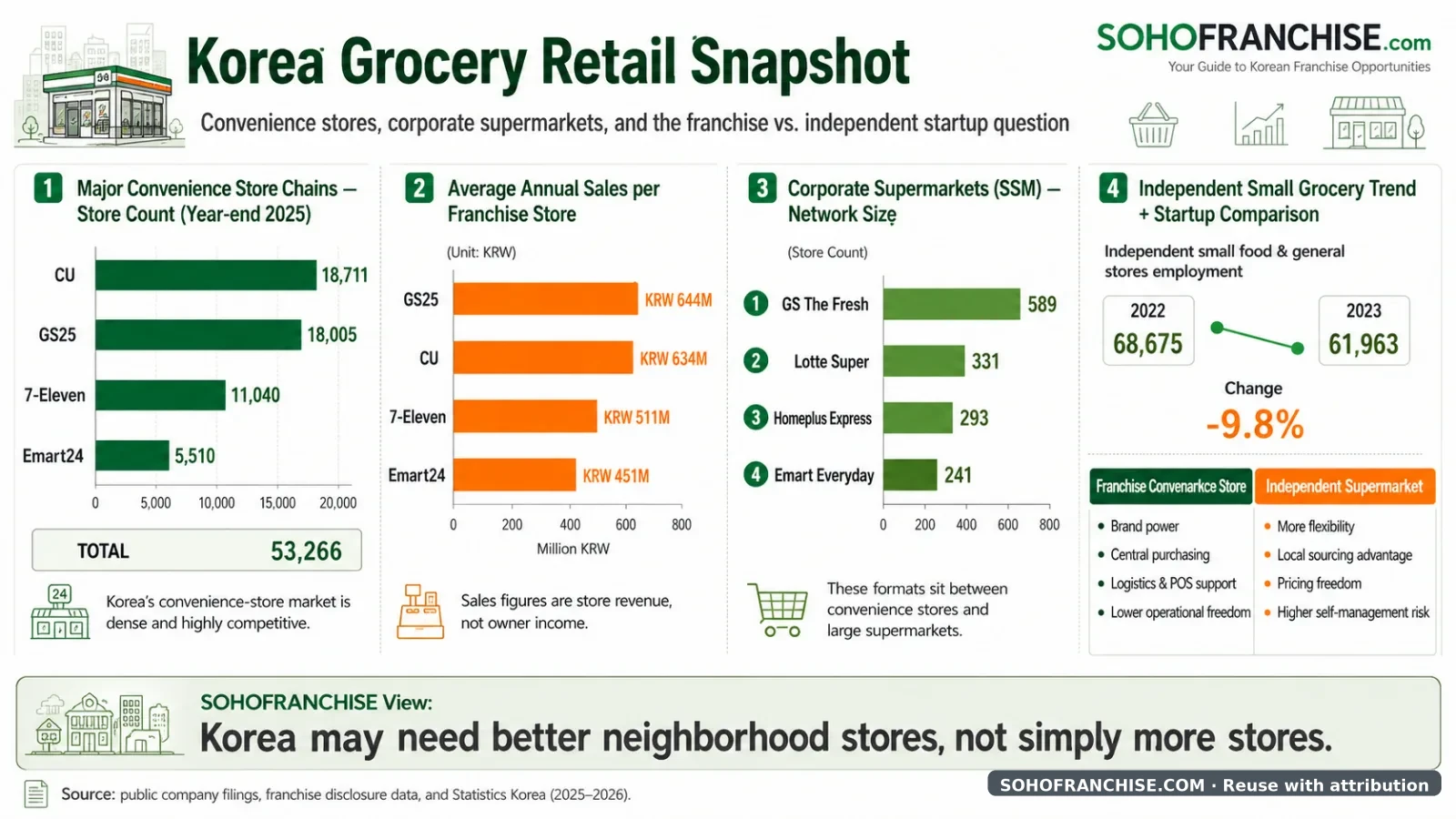
Korea does not necessarily need many more ordinary convenience stores. With more than 53,000 major-chain locations already operating nationwide, the market is extremely dense.
The opportunity is moving toward better stores rather than more stores.
For an entrepreneur with no retail experience, a major franchise can still provide the safer operating system. But a strong location alone is no longer enough, and the economics of rent, labor and profit sharing must be examined carefully.
For an experienced retailer or entrepreneur capable of developing direct purchasing relationships, an independent supermarket can provide greater upside because the owner controls purchasing, pricing and merchandising.
The traditional Korean gumeonggage may continue to disappear, but the neighborhood grocery business itself is not disappearing. Instead, it is evolving into a more sophisticated combination of supermarket, convenience store, food shop, local warehouse and last-mile delivery point.
The future winner may not be the biggest store or the most famous brand. It may be the retailer that understands a neighborhood better than anyone else.