

A Tiny Photo Shop in the Streets of Seochon
On a narrow street in Seochon, one of Seoul’s best-known historic neighborhoods, a small red storefront stands between a restaurant and a lottery shop.
The sign reads “AUTOFOTO.” Inside, there is no photographer, reception desk or sales employee. Customers enter, pose inside a compact booth, operate the system themselves and receive printed photographs.
It is a remarkably small business, but it represents several of Seoul’s strongest retail trends: unmanned operation, experience-based consumption, retro design, social-media sharing and tourism.
AUTOFOTO demonstrates that a store does not need a large floor area or many employees to create a memorable customer experience.
Smartphones have made photography available everywhere. However, this has not eliminated demand for printed photographs. Instead, physical photographs have become more emotional because they are no longer part of everyday life.
A printed photo strip offers something a smartphone image cannot fully reproduce. It is a physical souvenir that friends, couples and families can keep in a wallet, attach to a wall or share as part of a travel diary.
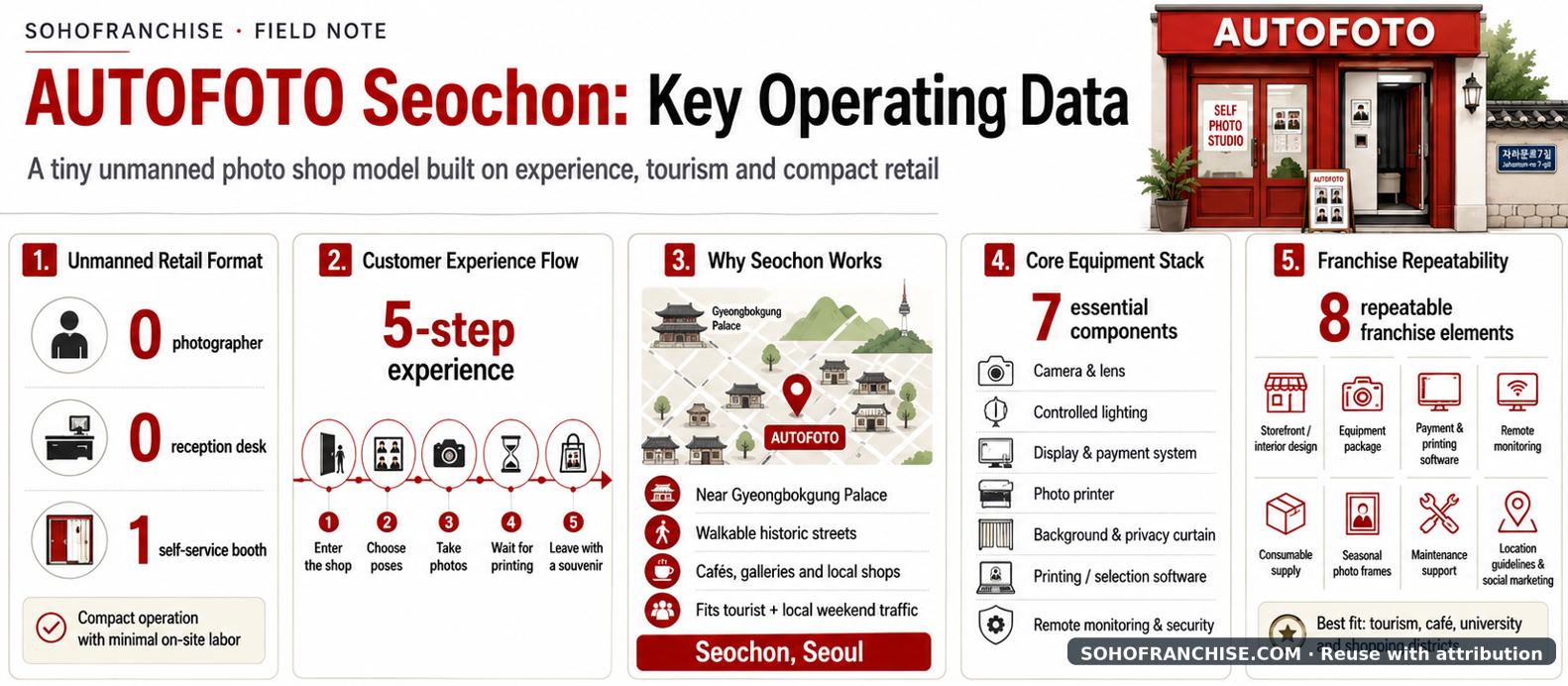
Customers are not simply paying for a photograph. They are paying for a short experience:
Entering a visually distinctive shop
Choosing how to pose
Taking pictures without a photographer
Waiting for the photographs to develop
Leaving with a physical memory
The entire process may take only a few minutes, but it creates both entertainment and a souvenir.
Why Seochon Is the Right Location
Seochon lies to the west of Gyeongbokgung Palace and is within walking distance of Gyeongbokgung Station, Tongin Market and numerous cafés, galleries, restaurants and independent shops.
Unlike a modern shopping mall, Seochon offers narrow streets, older buildings and an atmosphere that encourages visitors to walk slowly and explore. A small photo shop fits naturally into this environment.
Tourists visiting Gyeongbokgung Palace often wear rented hanbok and take photographs around the palace. Local visitors also come to Seochon for cafés, exhibitions, food and weekend walks. AUTOFOTO gives both groups an additional way to record their visit.
The location transforms the photo booth from a simple machine into part of a neighborhood experience.
The most noticeable element of the store is its red façade. The large cream-colored AUTOFOTO lettering can be recognized immediately from across the street.
Inside, the business uses wood, dark curtains and a red neon “FOTOS” sign to create a retro European atmosphere. The photography booth feels less like a modern vending machine and more like a small vintage studio.
This design is important. An unmanned shop cannot rely on an employee to explain its concept or invite people inside. The storefront must perform that role.
AUTOFOTO’s color, typography, lighting and sample photographs communicate the product before customers enter the shop.
The storefront itself therefore functions as:
A sign
An advertisement
A photo location
A brand identity
An invitation to enter
This is a useful lesson for all unmanned retail businesses. Automation should not result in a cold or anonymous space. Strong design becomes even more important when no employee is present.
The Economics of a Compact Unmanned Shop
An automated photo shop can operate in a much smaller space than a café, restaurant or conventional retail store. It does not need a kitchen, inventory shelves, customer seating or a large storage area.
Its essential components are relatively simple:
Camera and lens
Controlled lighting
Customer display and payment system
Photo printer
Background and privacy curtain
Software for image selection and printing
Remote monitoring and security equipment
Once the system is installed, the store can serve customers with minimal on-site staffing. The operator still needs to refill printing materials, clean the booth, inspect the equipment and respond to technical problems, but daily labor requirements can be substantially lower than those of a conventional shop.
The model also turns a very narrow property into a customer-facing business. Spaces that may be unsuitable for restaurants or general retail can potentially accommodate a photo booth.
However, “unmanned” does not mean “maintenance-free.” Print quality, lighting, cleanliness and equipment reliability directly affect the customer experience. A single malfunction can stop sales completely.
Tourism and the Souvenir Economy
As the number of international visitors to Seoul grows, demand will expand for small products and experiences that capture memories of individual neighborhoods.
Traditional souvenirs are usually purchased from a store. An unmanned photo shop is different because the customer creates the souvenir personally.
This makes the product:
Personal
Immediate
Easy to carry
Relatively affordable
Connected to a specific moment and location
Suitable for sharing on social media
The opportunity is especially strong in tourism districts such as Seochon, Bukchon, Samcheong-dong, Ikseon-dong, Hongdae and Seongsu-dong. Each location could offer frames, backgrounds or printed designs associated with its own neighborhood.
A Seochon photo frame might feature Gyeongbokgung Palace, a traditional roofline or a neighborhood map. Seasonal designs could celebrate cherry blossoms, autumn leaves, Christmas or the Korean New Year.
Multilingual instructions and international payment options would make the service even more accessible to tourists.
Can the Concept Be Franchised?
The basic structure of an unmanned photo shop is highly repeatable. A standardized franchise package could include:
Storefront and interior design
Photography equipment
Payment and printing software
Remote equipment monitoring
Consumable supply
Seasonal photo frames
Maintenance and technical support
Location selection guidelines
Social-media marketing materials
Because each outlet requires relatively little space, the concept can enter areas where larger franchises cannot operate.
Nevertheless, location remains critical. A photo booth needs steady pedestrian traffic and customers who are already in a social, recreational or tourism-oriented mood. Low rent alone cannot compensate for an unsuitable location.
The concept is most likely to succeed near palaces, universities, shopping streets, entertainment districts, tourist attractions and popular cafés.
A Small Store with a Large Lesson
AUTOFOTO in Seochon is easy to overlook because of its size. Yet it offers a useful lesson about the future of urban retail.
The store does not compete by offering a large inventory. It combines one machine, one recognizable interior and one simple emotional product: a memory.
Its retro appearance creates curiosity. Automation keeps the operating model compact. Printed photographs give the customer something physical, while digital culture helps the experience spread online.
As Seoul grows as an international tourism destination, these small experience-based businesses could become increasingly valuable. Visitors will need more than accommodation and food. They will look for enjoyable activities and personal objects that help them remember each neighborhood.
AUTOFOTO shows how even the narrowest storefront can participate in that market.
In the coming era of automated retail, the most successful unmanned shop may not be the one with the most advanced machine. It may be the one that understands human emotion best.
Field observation and photographs by JB Kim in Seochon, Seoul, on August 20, 2026.