
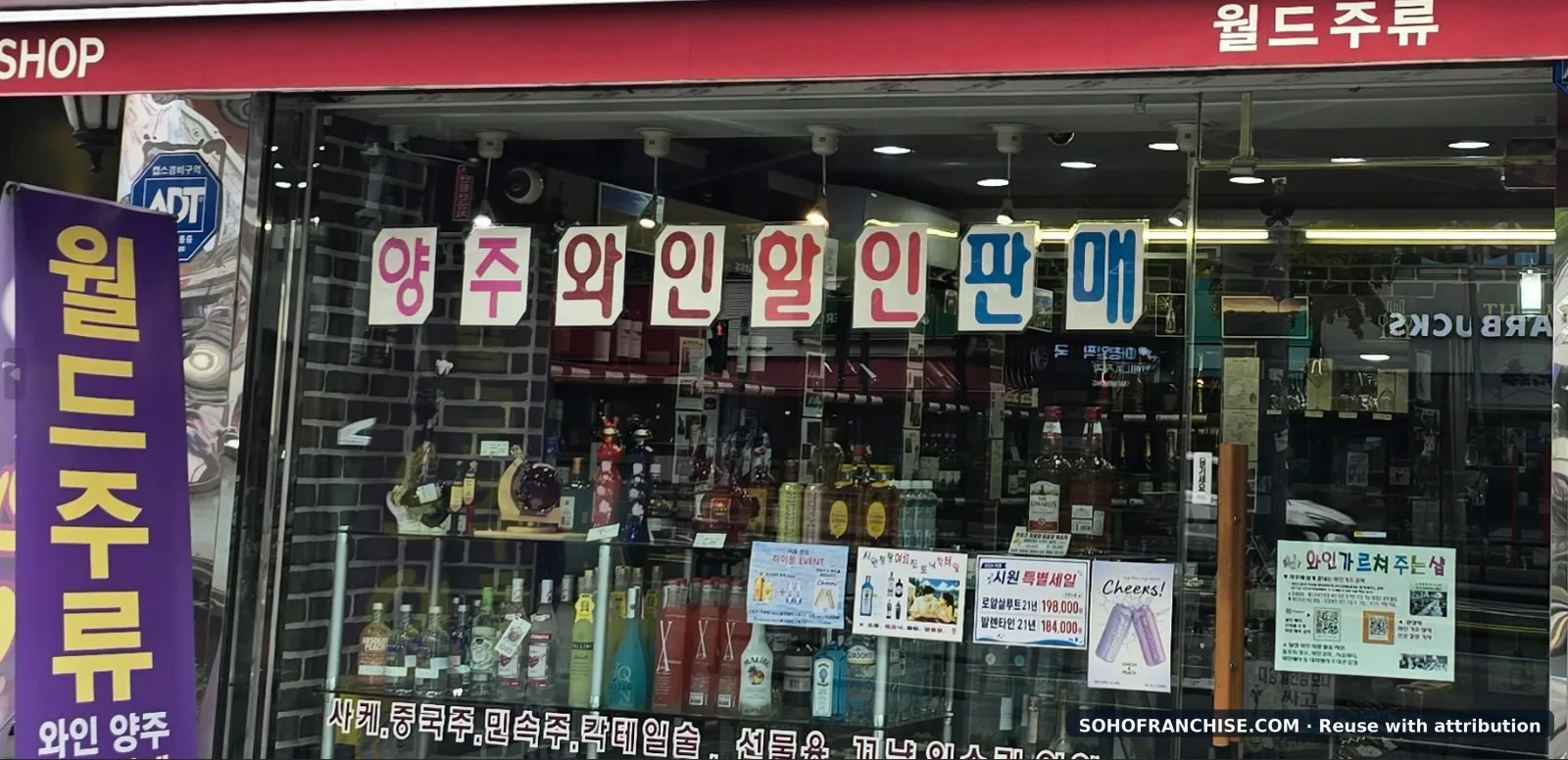
SEOUL — September 2026. A neighborhood liquor shop in Sinchon offers a useful reminder that alcohol retail in Korea is not just another convenience-store category. A wine-and-spirits store may appear simple from the outside, but behind the storefront lies one of the country’s most tightly regulated consumer-goods distribution systems.
For prospective founders, this means one thing: a liquor or wine shop can be profitable, but it is not a business where branding alone determines success. Licensing, product mix, wholesale access, legal compliance and inventory discipline matter just as much as location and customer traffic.
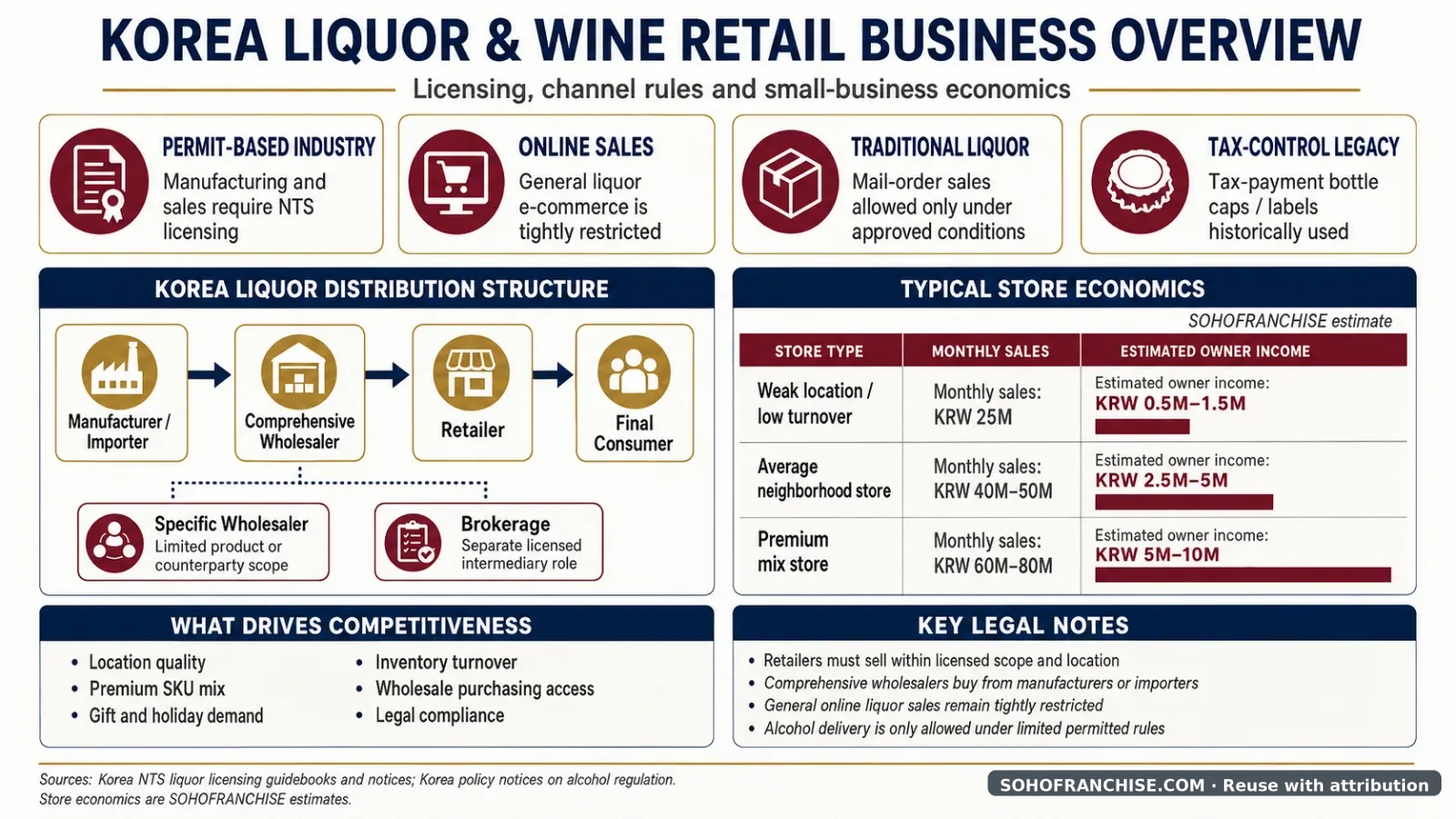
In Korea, liquor manufacturing and sales are permit-based activities, and unlicensed manufacturing or sales are illegal. The National Tax Service (NTS) also classifies liquor sales licenses by type, including wholesale, retail and brokerage categories, and the sales scope differs by license type. [Source] [Source] [Source]
Why Liquor Retail Still Looks Attractive
At first glance, the business has clear appeal. Compared with many food-service businesses, a liquor shop has no kitchen, less spoilage, lower staffing complexity and a product category that can benefit from gifting demand, holidays, imported-premium trends and repeat purchases.
Wine, whisky, craft beer and premium traditional liquor have also widened the market beyond basic soju and beer. In wealthy residential districts or university-adjacent neighborhoods, customers may purchase not only alcohol for daily consumption but also celebratory gifts, imported spirits and pairings for home dining.
This gives liquor retail one major advantage over many restaurant franchises: the operator is selling inventory rather than running a labor-intensive hospitality business.
But It Is Not an Easy Business
The challenge is that liquor retail is capital-heavy and regulation-heavy.
A founder must commit substantial working capital to inventory. Unlike a coffee shop, where ingredients turn quickly and branding can create high gross margins, a liquor retailer may have cash tied up in slow-moving bottles for months. Imported whisky, wine and premium spirits can improve margins, but they also increase inventory risk.
The business is also legally structured. For example, the NTS guidebook notes that a specialized retail license may retail only the categories stated in the license and only at the licensed place. [Source]
The Legal Structure of Korea’s Liquor Distribution Market
The Korean liquor market is not a free-form retail channel. It is a structured chain governed by licensing and tax control.
| Business Layer | Main Role | Key Legal Reality |
|---|---|---|
| Manufacturer / Importer | Produces or imports liquor | Must hold the appropriate production or import license |
| Comprehensive Liquor Wholesaler | Supplies broad ranges of liquor to downstream sellers | May purchase from manufacturers or importers and distribute wholesale under license |
| Specific Liquor Wholesaler | Handles limited products or counterparties | Scope is narrower than comprehensive wholesale |
| Liquor Brokerage | Intermediates transactions | Operates under separate licensing rules |
| Retailer | Sells to the final consumer | Must sell within licensed scope and location |
The NTS’s rules for liquor transactions state that a comprehensive liquor wholesaler must buy from liquor manufacturers and importers, showing that supply access is itself regulated rather than fully open-market. In addition, entry into comprehensive wholesale remains controlled enough that the NTS publishes annual notices on how many new comprehensive liquor wholesale licenses may be allowed. [Source] [Source] [Source]
What About Online Sales?
This is where many first-time founders misread the opportunity.
In Korea, ordinary liquor e-commerce is still heavily restricted. The government has repeatedly clarified that alcohol other than traditional liquor is not generally permitted for internet mail-order sales. Traditional liquor has a special channel under approved conditions, and the 2020 regulatory improvements also clarified limited rules for alcohol delivery together with food orders. [Source] [Source] [Source]
That means a wine shop in Korea cannot simply assume that it can scale like a normal online retailer. A founder needs to think in terms of store-based retail, local customer base, premium merchandising and repeat offline demand, not “Instagram and nationwide shipping” as the core model.
Korea’s Unique Bottle-Cap Tax Legacy
Korea’s liquor market also has a distinctive tax-administration history. For years, tax compliance in liquor was strongly tied to tax-payment bottle caps and tax labels — the famous napse byeongmage system. NTS notices continue to describe the quality and control rules for tax-payment caps and labels, including how they are manufactured, stored and tracked. More recently, the government has been modernizing the system, including shifting tax bottle-cap manufacturers toward a registration framework and simplifying some labeling rules. [Source] [Source] [Source] [Source]
In plain business terms, this matters because Korean liquor retail has long been treated as a tax-sensitive industry, not merely a consumer discretionary trade. This partly explains why regulation, labeling and permitted channels remain more detailed than in many other retail sectors.
A Historical Note: From Rough Distribution to Formalized Channels
Older Korean business memory often describes the soju-and-beer trade as a rougher business in the past, with territory-based relationships, opaque local channels and, at times, coercive middlemen. While this is difficult to quantify cleanly as an official national statistic, it helps explain why liquor distribution in Korea evolved with unusually strong tax-control and licensing mechanisms.
In other words, today’s formal, permit-based structure did not emerge by accident. It emerged partly because alcohol has always sat at the intersection of tax collection, public order and commercial control.
Expected Income: What Can a Small Liquor Retailer Actually Earn?
No official source can give one universal income number, because profitability depends heavily on rent, district income level, imported-product mix and inventory turnover. But a practical small-business model can still be estimated.
| Scenario | Monthly Sales | Estimated Gross Margin | Operating Costs | Estimated Owner Income |
|---|---|---|---|---|
| Weak location / low turnover | KRW 25M | 18%–20% | KRW 3.5M–4.5M | KRW 0.5M–1.5M |
| Average neighborhood store | KRW 40M–50M | 20%–24% | KRW 5M–7M | KRW 2.5M–5M |
| Strong premium mix store | KRW 60M–80M | 22%–27% | KRW 7M–10M | KRW 5M–10M |
These are SOHOFRANCHISE operating estimates, not government statistics. They assume one of the most important realities of the category: beer and soju move quickly but usually with lower margins, while wine, whisky and gift-oriented spirits improve margin but require more inventory and better merchandising.
For that reason, the business is often less attractive for founders with low starting capital. A store may look busy but still suffer if capital is locked in the wrong SKUs.
Can This Be Franchised?
Yes — but only to a point.
Liquor retail can be organized in a franchise-like way through shared branding, store format, joint purchasing, private labels and common merchandising. However, the underlying liquor license remains critical at the store level, and legal compliance cannot be outsourced away merely because the signboard belongs to a chain.
This is one reason Korea’s liquor-retail “franchise” sector is less straightforward than fast food or coffee. In practice, the market consists of a mix of independent stores, chain-style stores, department-store formats, convenience-store channels and premium specialty concepts.
For entrepreneurs, that means the key competitive edge is not only “franchise name recognition,” but also:
- wholesale purchasing power,
- premium SKU selection,
- gift demand and holiday demand,
- local affluent customer base,
- inventory control,
- and legal compliance.
SOHOFRANCHISE View: Attractive, But Best for Disciplined Operators
Would SOHOFRANCHISE recommend a liquor or wine retail business?
Yes — but selectively.
This is not a good business for operators who want a simple “buy low, sell high” storefront. It is better suited to disciplined founders who understand product curation, regulated distribution, local-market positioning and inventory finance.
Among retirees or second-career founders, the category may actually be more attractive than a labor-intensive food-service franchise — but only if they avoid oversized stores and overstocking. A compact, well-curated neighborhood liquor shop with premium wine, whisky gifts, imported beer and strong holiday merchandising may produce a stable owner income. A badly located, poorly curated store may become an expensive warehouse with a signboard.
The core lesson is simple: in Korea, liquor retail is not merely about alcohol. It is about regulation, cash flow, product mix and control of the channel.
Field photo: A neighborhood liquor and wine shop near Sinchon, Seoul. Photo by SOHOFRANCHISE, September 2026.