
A Hidden Temple in the Heart of Seoul
Seoul is famous for its royal palaces, modern skyscrapers, vibrant shopping districts, and fast-moving urban life. Yet beyond the city's busy streets, there are places where centuries of history remain quietly alive.
One of these hidden treasures is Bongwonsa Temple, a historic Buddhist sanctuary nestled on the slopes of Ansan Mountain in Seodaemun-gu, Seoul.
For international visitors seeking something beyond the usual tourist attractions, Bongwonsa offers a fascinating combination of Buddhist spirituality, traditional Korean architecture, seasonal landscapes, and an unexpected connection to the history of the Korean language.
Most remarkably, the temple is home to the magnificent Samcheonbuljeon, or Hall of 3,000 Buddhas, and the historic site where the organization that became the Korean Language Society was founded in 1908.
More Than 1,100 Years of Buddhist History
Bongwonsa traces its origins to 889 CE, during Korea's Unified Silla period, when the Buddhist monk Doseon is traditionally credited with founding a temple called Banyasa.
Over the centuries, the temple witnessed the changing fortunes of Korean Buddhism through the Goryeo and Joseon dynasties.
In the eighteenth century, the temple was relocated and rebuilt under the patronage of the Joseon royal court, acquiring the name Bongwonsa.
Today, Bongwonsa is a principal temple of the Taego Order of Korean Buddhism, a tradition known for preserving important elements of Korean Buddhist ceremonial culture.
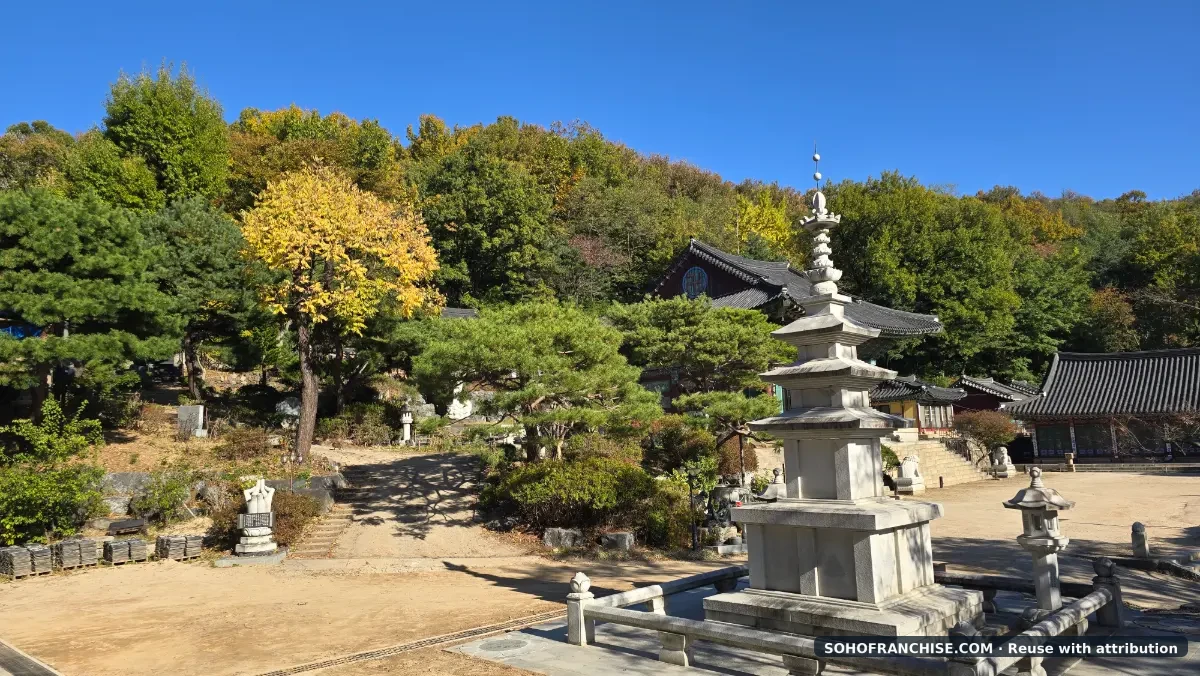
Despite its proximity to central Seoul, the temple retains a peaceful atmosphere surrounded by pine trees, wooded hillsides, stone monuments, and traditional Buddhist buildings.
Samcheonbuljeon: The Hall of 3,000 Buddhas
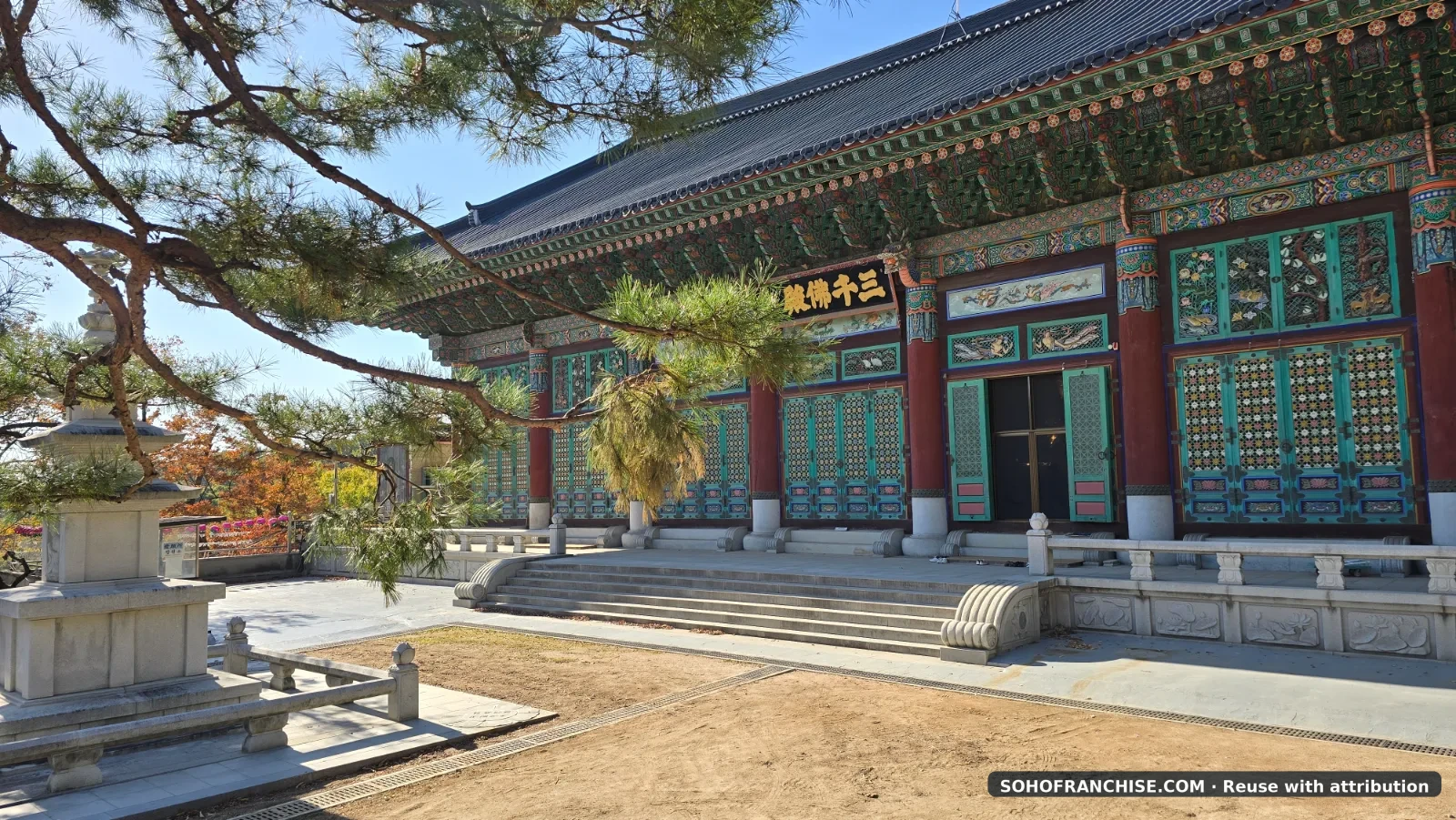
One of Bongwonsa's most remarkable architectural landmarks is Samcheonbuljeon (三千佛殿), literally the Hall of 3,000 Buddhas.
The name refers to a Buddhist tradition associated with the Buddhas of the three great periods of time: past, present, and future.
In this tradition, one thousand Buddhas are associated with each of the three periods, symbolizing the immeasurable reach of enlightenment and the possibility of awakening across time.
For visitors unfamiliar with Buddhism, the hall offers an accessible introduction to a profound spiritual idea: enlightenment is not confined to a single historical moment or individual.
The building itself is striking, with a sweeping traditional tiled roof, richly painted wooden structures, and turquoise doors decorated with intricate floral patterns.
Its scale and craftsmanship make it one of the most memorable sights within the temple complex.

Understanding the Meaning of Three Thousand Buddhas
The number 3,000 is not simply an expression of architectural grandeur. It represents a Buddhist vision of enlightenment extending across the past, present, and future.
Rather than understanding Buddhism only through the historical Buddha, Siddhartha Gautama, the tradition invites visitors to contemplate a much wider spiritual universe.
Inside the hall, numerous Buddha images create a powerful atmosphere of devotion and contemplation.
Visitors should remember that Samcheonbuljeon is an active religious space. Quiet observation and respect for worshippers are essential.
The Art of Dancheong: Korea's Colorful Buddhist Architecture
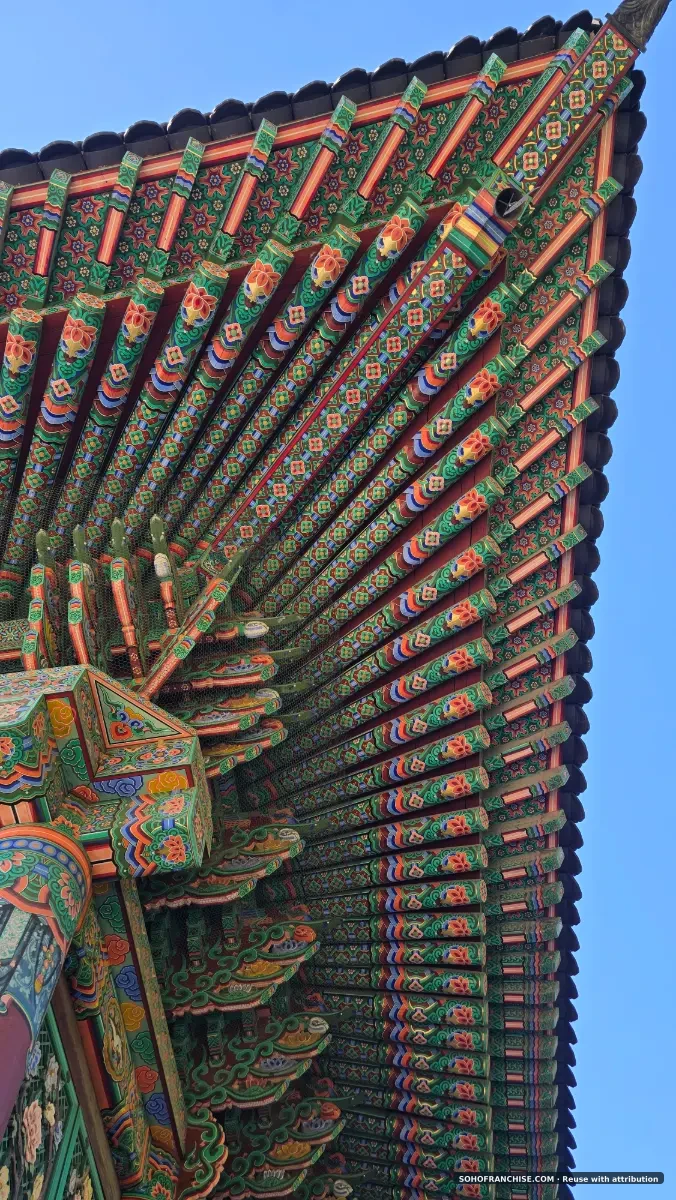
Look upward beneath the roof of Samcheonbuljeon and another extraordinary aspect of Korean heritage becomes visible.
The wooden beams and brackets are covered with dancheong, the traditional decorative painting used in Korean temples and important historical buildings.
Green, blue, red, yellow, and white combine in intricate geometric and floral patterns.
Beyond their decorative beauty, these painted designs carry cultural symbolism and help protect wooden architectural surfaces.
For photographers and architecture enthusiasts, the underside of a Korean temple roof can be just as fascinating as the building itself.
An Unexpected Connection: The Birthplace of the Korean Language Society
Perhaps the most surprising part of Bongwonsa's history has little to do with religion.
On August 31, 1908, a group of Korean language scholars and educators gathered at Bongwonsa to establish the Gungmun Yeongu Hakhoe, or Korean Language Research Society.
Among the central figures was Ju Si-gyeong, a pioneering scholar who devoted his life to studying, teaching, and promoting the Korean language and writing system.
The organization eventually developed into today's Hangeul Society, also known as the Korean Language Society.
This gathering took place during a turbulent period in Korean history, when the country faced increasing pressure from imperial Japan and profound political and social change.
The study and preservation of the Korean language became an important part of maintaining cultural identity.
For international visitors familiar with Hangeul, Korea's distinctive writing system, the connection is especially meaningful.
Hangeul was created in the fifteenth century under King Sejong. The 1908 gathering at Bongwonsa was not the creation of the alphabet, but an important milestone in the modern scholarly movement to study, teach, and preserve Korean language and writing.
A Monument Remembering 1908
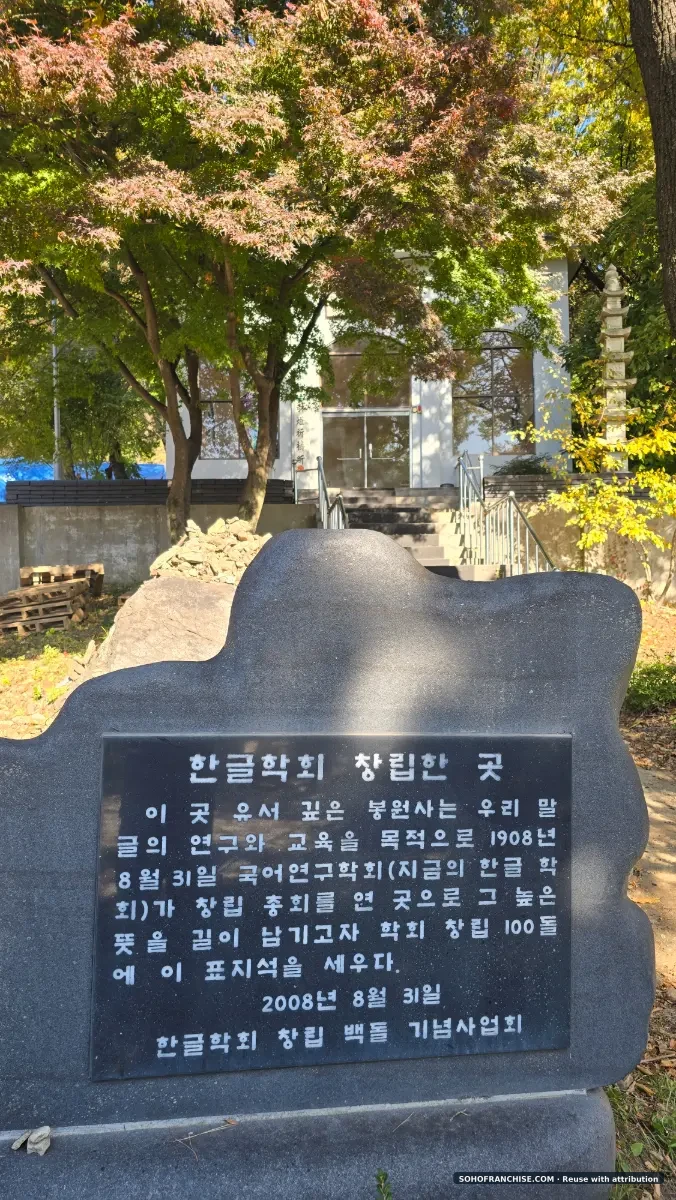
In 2008, the Hangeul Society commemorated its 100th anniversary by installing a memorial stone at Bongwonsa.
The monument records the founding meeting held here on August 31, 1908, and honors the scholars who contributed to the preservation and development of Korean language studies.
It is an easily overlooked landmark, but one that connects this Buddhist temple to the intellectual and cultural history of modern Korea.
Living Buddhist Heritage: Music, Ritual, and Yeongsanjae
Bongwonsa is more than a collection of historical buildings. It remains an important center for Korean Buddhist ritual traditions.
The temple is particularly associated with Yeongsanjae, a traditional Buddhist ceremony commemorating the Buddha's teaching at Vulture Peak.
The ritual brings together Buddhist chanting, ceremonial movement, offerings, and traditional music.
Yeongsanjae was inscribed on UNESCO's Representative List of the Intangible Cultural Heritage of Humanity in 2009.
For culturally curious travelers, this tradition offers a deeper understanding of Korean Buddhism as a living cultural practice rather than simply an ancient religion.
A Peaceful Autumn Escape in Seoul
While Bongwonsa is worth visiting throughout the year, autumn brings a special atmosphere.
Golden ginkgo leaves, colorful maples, evergreen pines, and clear blue skies provide a beautiful contrast to the temple's traditional painted buildings.
The quiet courtyards and nearby wooded paths make it an appealing destination for travelers interested in photography, architecture, and gentle walking.
Visitors can also explore the surrounding Ansan Mountain area, which offers forest trails and an opportunity to experience Seoul from a slower, more reflective perspective.
Visitor Information
Location: Bongwonsa Temple, 120 Bongwonsa-gil, Seodaemun-gu, Seoul, South Korea.
Korean name: 봉원사 (Bongwonsa).
Recommended visit: Allow approximately 45–90 minutes for the temple grounds, with additional time for nearby walking trails.
Getting there: Public transportation is available from the Sinchon area. Seoul bus 7024 has traditionally served the temple area; visitors should check current routes before traveling.
Visitor etiquette: Dress respectfully, speak quietly near prayer halls, avoid interrupting ceremonies, and check photography restrictions before taking pictures inside religious buildings.
Google Maps:
Find Bongwonsa Temple on Google Maps
Why Bongwonsa Deserves a Place on Your Seoul Itinerary
What makes Bongwonsa special is the way it connects different chapters of Korean history in one place.
Its Buddhist origins reach back more than a millennium. Its Samcheonbuljeon reflects the spiritual imagination and craftsmanship of Korean Buddhism. Its memorial to the Hangeul Society recalls the modern struggle to preserve Korea's linguistic and cultural identity.
For travelers looking beyond Seoul's famous landmarks, Bongwonsa offers something memorable: a peaceful sanctuary where faith, architecture, nature, and the Korean language share a remarkable history.
Photography and editorial coverage by SOHOFRANCHISE, Seoul, South Korea.