
How Seoul's historic streets, outdoor dining culture and independent businesses are creating new opportunities for tourism, hospitality and the next generation of franchises.
The World's Coolest Neighborhood Is in Old Seoul
While Seoul is internationally recognized for its advanced technology, K-pop culture and futuristic skyline, one of its oldest districts has recently captured global attention.
In September 2026, British travel and culture publication Time Out ranked Jongno 3-ga as the world's No. 1 coolest neighborhood in its annual global ranking.
The recognition was not based on luxury hotels, shopping malls or expensive restaurants. Instead, it celebrated a unique combination of history, community, traditional architecture, independent businesses and vibrant nightlife.
At the center of this transformation is yajang, Korea's outdoor dining culture, alongside traditional pojangmacha, or tent-style street food stalls commonly known as pocha.
Every evening, ordinary streets turn into lively social spaces where office workers, younger generations, longtime residents and international visitors gather around small tables.
Unlike planned entertainment districts, Jongno 3-ga's attraction has grown organically over generations.
For entrepreneurs and franchise developers, this raises an important question:
Can the success of an authentic neighborhood become a scalable business model without destroying the character that made it attractive?
1. Yajang: Why Outdoor Dining Has Become a Global Attraction
Yajang generally refers to eating and drinking outdoors, often at tables placed outside restaurants and bars. Pojangmacha represents a more traditional version of this culture, using temporary stalls or tented seating.
The pocha streets around Jongno 3-ga, particularly Donhwamun-ro 11-gil, are among Seoul's best-known examples.
Here, the dining experience is remarkably simple. Customers sit close together, share Korean dishes such as kimchi pancakes, grilled meat, seafood and spicy snacks, and enjoy conversation over drinks.
There is no elaborate interior design and often little separation between the street and the dining space.
Yet that simplicity has become a competitive advantage.
For international visitors, the attraction is not merely Korean food. It is the opportunity to participate in an everyday social experience that feels genuinely local.
The commercial appeal can be understood through three factors: social interaction, distinctive atmosphere and cultural authenticity.
Traditional street dining also encourages visitors to explore surrounding alleys, creating opportunities for neighboring cafés, restaurants and retailers.
However, outdoor seating arrangements and operating permissions vary by location. Any commercial model must comply with local licensing, public-space regulations, sanitation requirements and neighborhood standards.
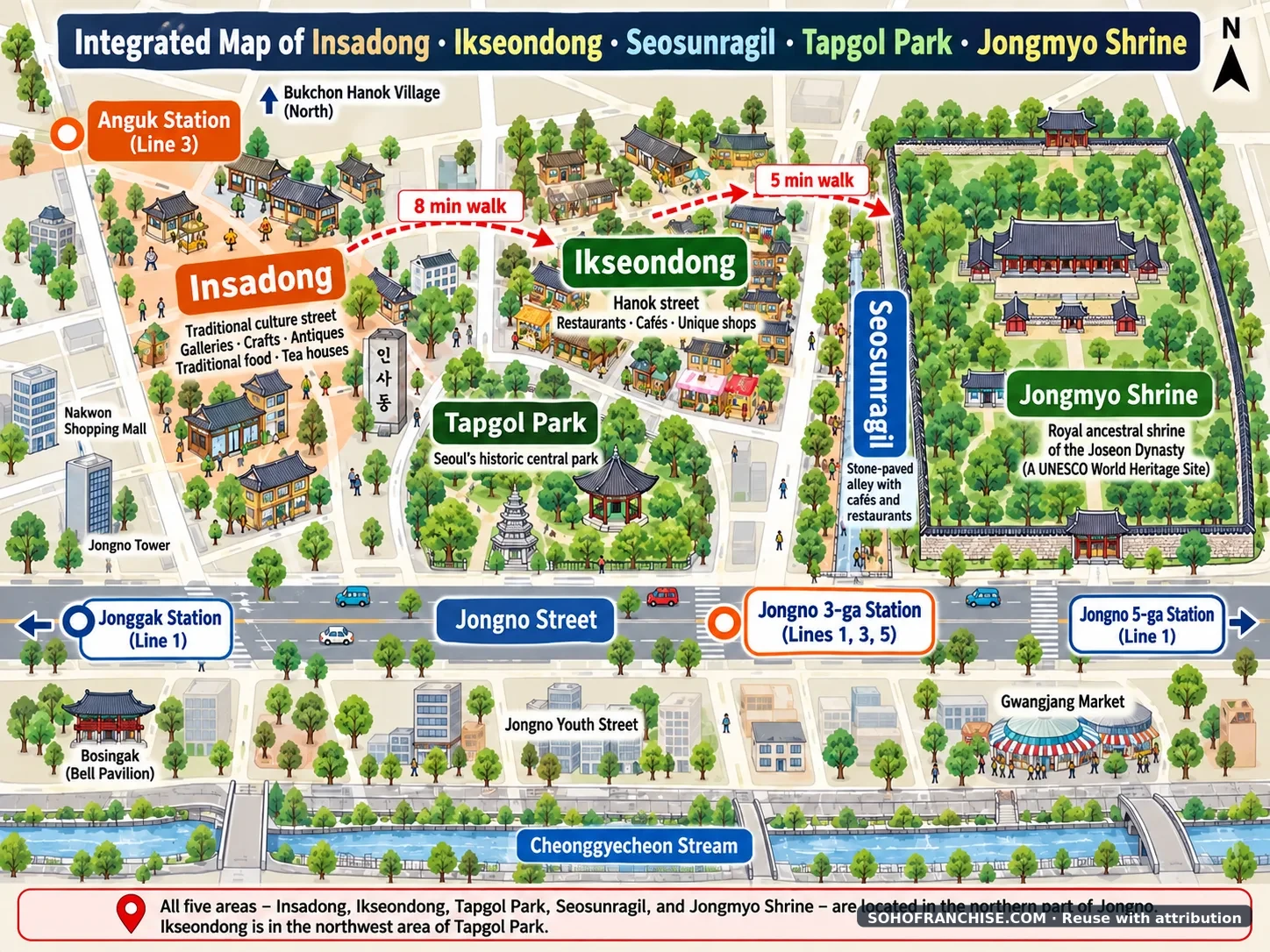
2. A Walking Guide to Old Seoul: Five Historic Districts in One Area
Jongno 3-ga is an exceptionally convenient starting point for exploring Seoul's historic center.
Subway Lines 1, 3 and 5 connect at Jongno 3-ga Station, providing access to several important destinations within walking distance.
Insadong — Traditional Culture and Creative Commerce
Located west of Ikseon-dong, Insadong is known for Korean traditional arts, antique shops, calligraphy, galleries, pottery, handicrafts and tea houses.
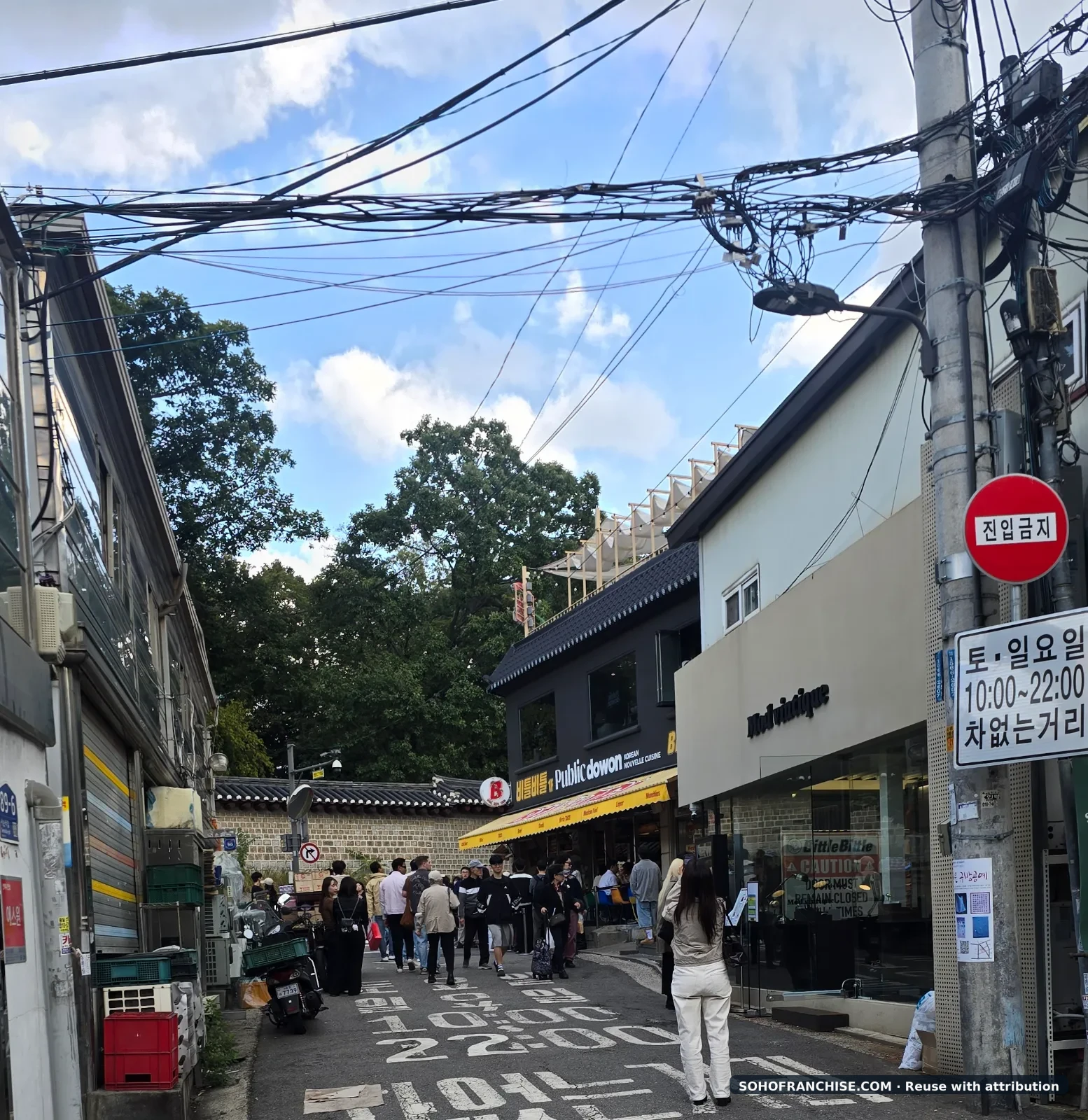
Its streets combine cultural heritage with modern retail.
Visitors can browse small galleries, discover traditional Korean products and enjoy tea in restored buildings.
For entrepreneurs, Insadong illustrates how cultural identity can support specialty retail and experience-based businesses rather than conventional mass-market shopping.
Ikseon-dong — The Reinvention of Hanok Architecture
Ikseon-dong has emerged as one of Seoul's most recognizable lifestyle destinations.
Its narrow streets contain historic hanok buildings, many of which have been converted into cafés, bakeries, restaurants and boutique shops.
The neighborhood demonstrates a powerful commercial principle: an existing architectural environment can become a unique business asset when thoughtfully adapted for contemporary use.
A successful business here does not necessarily require a large commercial space. Smaller formats can be effective when supported by distinctive products, excellent service and strong visual identity.
Tapgol Park — The Historical Heart of Modern Korea
Tapgol Park is more than an urban green space.
It is closely associated with Korea's March 1 Independence Movement of 1919 and remains an important landmark in the country's modern history.
Located near Insadong and Jongno 3-ga Station, it provides visitors with an opportunity to understand Seoul beyond shopping and nightlife.
This historical depth adds educational value to the surrounding tourist economy.
Seosulla-gil — Craftsmanship Beside a UNESCO Heritage Site
Running along the western side of Jongmyo Shrine, Seosulla-gil is becoming an attractive destination for independent businesses.
Traditional stone walls, quiet walkways, craft studios, jewelry workshops, cafés and small bars create a distinctive atmosphere.
Unlike conventional entertainment streets, the area's appeal comes from its intimate scale and relationship with its historic surroundings.
For lifestyle businesses, it offers an example of how independent craftsmanship, cultural heritage and modern hospitality can reinforce one another.
Jongmyo Shrine — Heritage Beyond Commercial Tourism
Jongmyo Shrine is a UNESCO World Heritage Site dedicated to the ancestral rites of the Joseon Dynasty's kings and queens.
Its solemn architecture and historical significance provide an important contrast to Jongno's lively dining streets.
For visitors, the combination of Jongmyo, Seosulla-gil and Ikseon-dong offers a rare opportunity to experience Korean history and contemporary urban culture within a compact area.
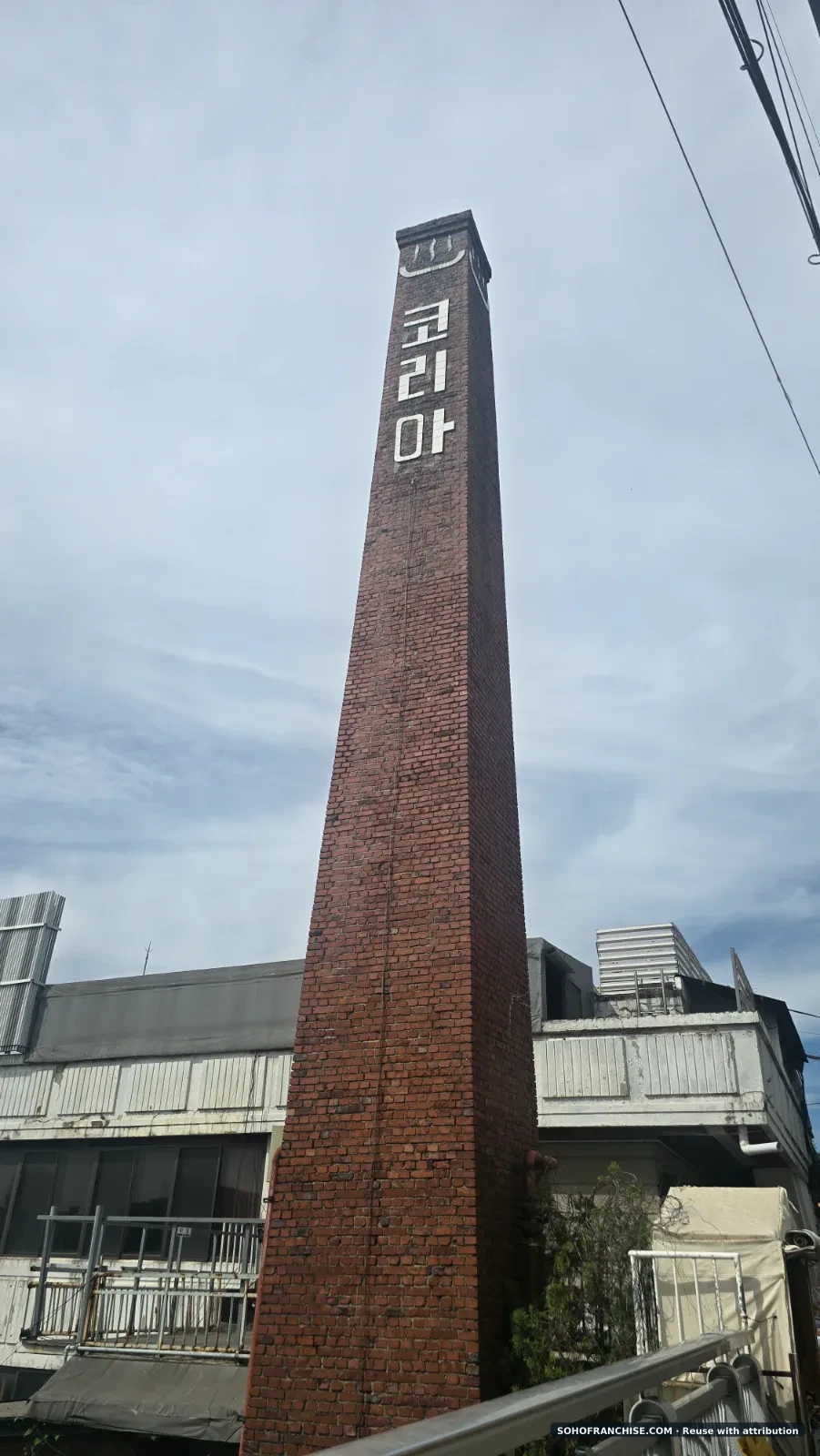
Those wishing to explore further can visit Gwangjang Market, known for traditional Korean food, or walk along Cheonggyecheon Stream.
Together, these destinations form an appealing Old Seoul itinerary.
3. What Makes Jongno 3-ga Commercially Different?
Many international tourism districts depend heavily on large brands, hotels, shopping centers and organized entertainment.
Jongno 3-ga operates differently.
Its commercial ecosystem is shaped by a diverse combination of small businesses, including family-operated restaurants, independent cafés, traditional merchants, specialized retailers and emerging lifestyle brands.
Each business contributes to the neighborhood's overall identity.
The area also accommodates different customer groups throughout the day.
During daytime hours, visitors explore cultural landmarks, markets and traditional shops. In the afternoon, cafés and boutique businesses attract shoppers and tourists. In the evening, restaurants and outdoor dining become more active.
This creates a local economy that is not dependent on a single attraction or shopping period.
The neighborhood itself functions as a destination brand, even when its businesses are independently owned.
That collective identity is particularly relevant to franchise developers seeking alternatives to standardized shopping-mall expansion.
4. The Franchise Opportunity: Standardize Operations, Not the Neighborhood
Traditional franchise systems often rely on standardized store interiors, menus, equipment and marketing.
Such models can deliver operational efficiency, but excessive uniformity may work against the identity of a historic tourism district.
Jongno suggests a different approach.
A new generation of tourism-oriented franchises could combine a repeatable operating system with a locally adapted customer experience.
Korean Outdoor Dining and Social Food Concepts
A small-format Korean restaurant could reproduce key elements of the pocha experience through shareable menus, approachable pricing, efficient kitchens and casual hospitality.
The atmosphere could be recreated inside licensed restaurants or in legally approved outdoor dining spaces.
Hanok-Inspired Cafés and Specialty Bakeries
Brands could develop distinctive beverages, Korean desserts and bakery products while adapting interior design to individual buildings and neighborhoods.
In heritage areas, architectural preservation should take priority over imposing a uniform corporate appearance.
Craft and Cultural-Experience Franchises
Workshops featuring Korean traditional crafts, personalized gifts, small exhibitions or cultural demonstrations could become an alternative to conventional souvenir retail.
Such businesses could incorporate local artisans, making cultural participation part of the customer experience.
The key principle is simple:
Standardize what customers cannot see. Differentiate what customers come to experience.
Supply chains, food safety, staff training, reservation systems, quality management and financial controls can be standardized.
The store's atmosphere, collaboration with local artisans, product selection and architectural expression can remain locally distinctive.
5. Five Principles for Building a Successful Tourism Franchise
The Jongno experience suggests several practical principles for investors and franchise operators.
First: Build a Destination Experience
Customers should have a reason to visit beyond convenience or price. Authentic food, local culture, craftsmanship and personal interaction can make the business memorable.
Second: Design for Multiple Customer Groups
A concept that appeals only to weekend tourists may face unstable demand. Serving residents, office workers and domestic visitors can improve resilience.
Third: Make International Access Easy
Clear multilingual menus, transparent prices, digital payment options and well-trained employees can reduce barriers for foreign customers without removing local character.
Fourth: Protect Unit Economics Before Expanding
Operators should test average customer spending, labor productivity, rent-to-sales ratios, seasonal demand and operating margins before introducing a franchise model.
Visitor popularity alone does not establish profitability.
Fifth: Develop Partnerships with the Existing Community
Local suppliers, artisans, property owners and established independent merchants should have opportunities to benefit from commercial growth.
A successful franchise must create value not only for the franchisor and franchisee but also for the neighborhood in which it operates.
6. The Risk of Becoming Too Popular
Global recognition can accelerate tourism and commercial investment. It can also create problems.
Rising rental costs, overcrowding, noise, pressure on residents and the replacement of independent businesses with repetitive commercial concepts may gradually weaken a neighborhood's appeal.
Jongno 3-ga is especially sensitive because it combines heritage sites, residential communities, longstanding businesses and diverse social groups.
If every traditional restaurant is replaced by an identical themed café, the original attraction may eventually disappear.
Responsible franchise expansion therefore requires restraint.
Business developers should consider locations beyond the most sensitive heritage corridors, preserve historic structures where appropriate and work with local communities before expanding.
The objective should not be to turn Old Seoul into a commercial theme park.
It should be to make its living culture economically sustainable.
7. From Jongno to the World: Can This Business Model Travel?
The underlying principles of Jongno's appeal are not limited to Korea.
Historic neighborhoods in Tokyo, Taipei, Bangkok, Lisbon and other cities face similar questions about tourism, preservation and small-business growth.
An internationally scalable model could combine Korean-style casual dining, culturally distinctive retail, compact store formats and neighborhood-specific experiences.
Yet exporting the idea should not mean copying Jongno's streets, architecture or community.
Instead, franchise operators could create operating platforms that allow local businesses to retain their identity while benefiting from shared technology, purchasing, training and marketing systems.
That may provide a more sustainable alternative to conventional franchise expansion based entirely on identical branded outlets.
Conclusion: Authenticity Is the Real Competitive Advantage
Jongno 3-ga's recognition as the world's coolest neighborhood in 2026 offers more than a new tourism headline.
It demonstrates the commercial potential of places where history, independent entrepreneurship and contemporary social culture coexist.
For visitors, Old Seoul provides an experience that cannot easily be reproduced inside a modern shopping mall.
For small-business owners, the district illustrates how traditional spaces can find new economic roles.
For franchise developers, it suggests a fundamental shift in strategy.
The next successful franchise may not be the one that looks identical everywhere. It may be the one that delivers consistent quality while allowing every location to remain genuinely different.
Jongno's greatest business lesson is not how to replicate its famous streets.
It is how to preserve what makes a place worth visiting in the first place.
References and Further Reading
- Time Out — The Coolest Neighbourhoods in the World 2026
- Korea Tourism Organization — Official Travel Information
- Visit Seoul — Official Seoul Tourism Guide
- UNESCO World Heritage Centre — Jongmyo Shrine
SOHOFRANCHISE Editorial | Exploring tourism, small business and franchise opportunities in evolving global markets.