
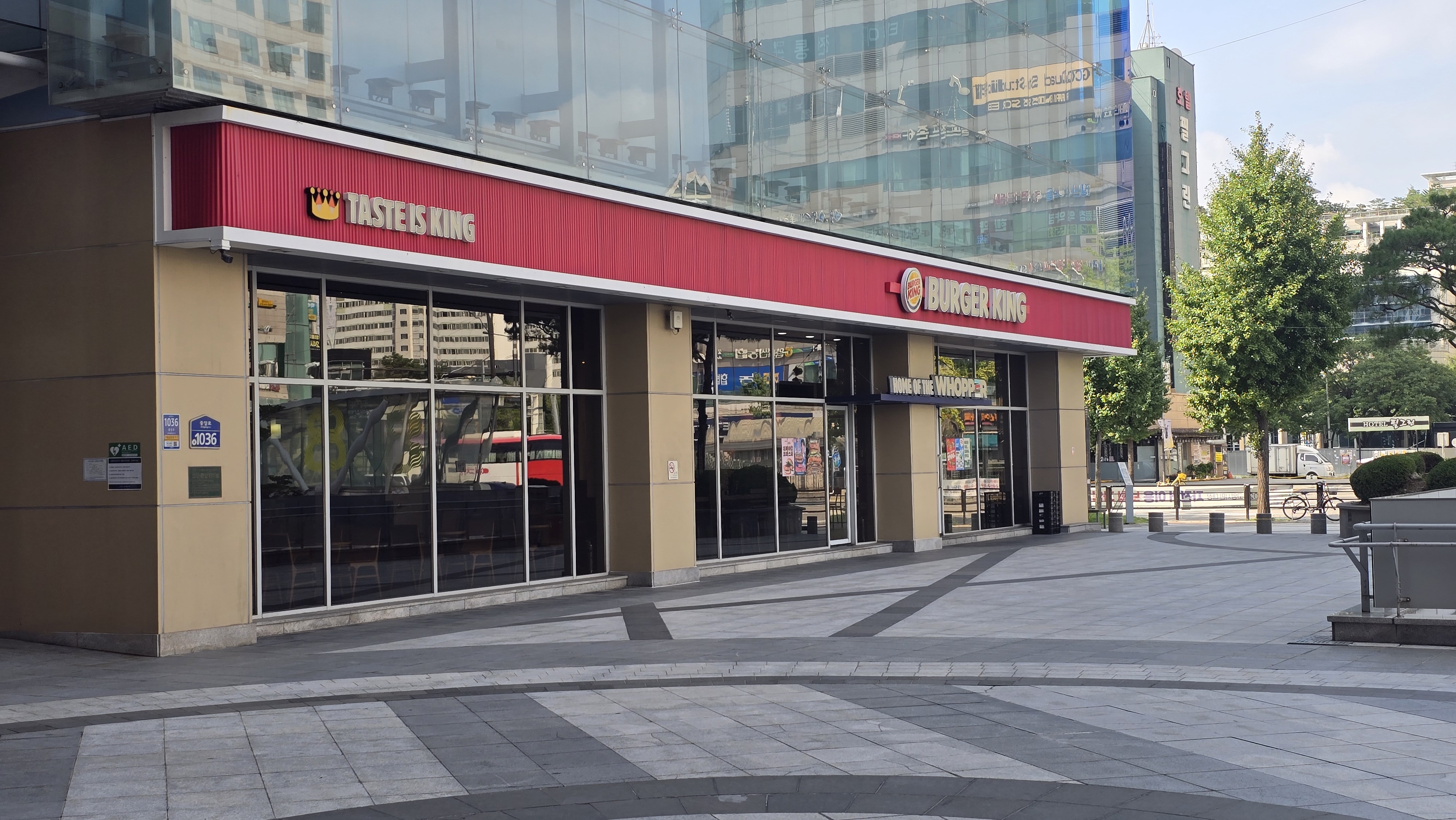
Depending on the definition used, Korea’s burger and related quick-service market is now worth roughly KRW 4 trillion to KRW 5 trillion a year. Embrain’s purchase data estimated consumer spending in the burger, sandwich and toast category at KRW 4.03 trillion in 2025, up 2.3% from the previous year. Euromonitor separately estimated Korea’s burger market at around KRW 4.2 trillion in 2024 and projected it to approach KRW 5 trillion in 2025.
The interesting part for entrepreneurs, however, is not simply which burger tastes best. The five major brands operate under very different ownership structures, investment requirements and franchise strategies.
McDonald’s Leads Sales, But Not Store Count
McDonald’s Korea remains the largest operator by revenue. The company recorded approximately KRW 1.43 trillion in revenue in 2025, followed by Lotte GRS, operator of Lotteria, with KRW 1.12 trillion and BKR, operator of Burger King Korea, with KRW 892.2 billion.
Mom’s Touch reported approximately KRW 479 billion in revenue, while KFC Korea generated about KRW 378 billion.
| Major Operator / Brand | 2025 Revenue | Approx. Share of Five Operators |
|---|---|---|
| McDonald’s Korea | KRW 1.431 trillion | 33.3% |
| Lotte GRS / Lotteria | KRW 1.119 trillion | 26.0% |
| BKR / Burger King | KRW 892.2 billion | 20.8% |
| Mom’s Touch | KRW 479.0 billion | 11.1% |
| KFC Korea | KRW 378.0 billion | 8.8% |
Important: this table is a revenue-footprint comparison rather than an audited burger-only market-share table. Lotte GRS operates businesses other than Lotteria, while Mom’s Touch and KFC also generate significant chicken sales. It is therefore more useful as an indication of corporate scale than as a pure burger-market share calculation.
Consumer Purchase Data Shows a Three-Way Burger War
Consumer purchase data provides another perspective. Embrain’s Purchase Deep Data ranked McDonald’s first in burger-franchise purchase value in late 2025. Burger King moved into second place during the fourth quarter, ahead of Lotteria, followed by Mom’s Touch and KFC.
The rankings also vary significantly by age. In the first quarter of 2026, Lotteria ranked particularly strongly among consumers in their teens and younger as well as consumers in their 60s, while McDonald’s led among consumers in their 30s, 40s and 50s.
This suggests that Korea does not have a single dominant burger brand across every customer segment.
Store Count Tells a Completely Different Story
By physical store network, domestic brands dominate.
| Brand | Approx. Stores | Franchised | Company-Owned | Franchise Ratio |
|---|---|---|---|---|
| Mom’s Touch | 1,455 | 1,444 | 11 | 99.2% |
| Lotteria | 1,286 | 1,209 | 77 | 94.0% |
| Burger King | 517 | 132 | 385 | 25.5% |
| McDonald’s | About 401 | 41 | About 360 | 10.2% |
| KFC | About 242 | 33 | 209 | 13.6% |
The contrast is striking.
Mom’s Touch and Lotteria are fundamentally franchise networks. Local franchisees provide most of the capital required for expansion.
McDonald’s operates almost the opposite model in Korea. Its company-owned store ratio has increased as the number of franchised restaurants has declined. McDonald’s had 83 franchised restaurants in 2022, but the number fell to approximately 41 by 2025.
Burger King sits between the two models. Roughly one quarter of its Korean restaurants are franchised, while the majority continue to be operated directly by BKR.
KFC is also changing. After operating Korea primarily through company-owned restaurants for decades, it began a formal franchise business in 2024 and is gradually increasing franchise locations.
Who Really Has the Largest Network?
Looking only at the four largest burger networks — Mom’s Touch, Lotteria, Burger King and McDonald’s — there are roughly 3,660 restaurants.
| Brand | Approx. Share of Four-Brand Store Network |
|---|---|
| Mom’s Touch | 39.8% |
| Lotteria | 35.1% |
| Burger King | 14.1% |
| McDonald’s | 11.0% |
This is one of the most important characteristics of the Korean market: McDonald’s can lead revenue despite operating only a fraction of the number of stores operated by Mom’s Touch or Lotteria.
How Much Does It Cost to Open a Burger Franchise in Korea?
Startup investment varies enormously. Store size, drive-through requirements, kitchen specifications and ownership models make a direct comparison difficult.
| Brand | Published / Disclosure-Based Investment | Typical Model | Entry Difficulty |
|---|---|---|---|
| McDonald’s | About KRW 1.03 billion disclosure benchmark | Large-format / DT, mostly company-owned | Very High |
| Burger King | About KRW 737 million disclosure benchmark | 40–50 pyeong or larger | High |
| Lotteria | Official 40-pyeong standard package about KRW 330 million; broader disclosure-based investment can be substantially higher | Shopping district / mall / DT | Medium to High |
| Mom’s Touch | Roughly KRW 110–160 million depending on format and disclosure basis | Neighborhood / delivery / small-format | Medium |
| KFC | About KRW 817 million latest disclosure benchmark | Large QSR format | High |
| No Brand Burger | About KRW 111 million for current 15-pyeong published model before VAT and property costs | Compact franchise model | Medium to Low |
Lotteria
Lotte GRS currently publishes one of the clearest franchise investment schedules. For a standard 40-pyeong Lotteria restaurant, initial franchise and training-related fees total approximately KRW 18.81 million, while interior construction, restaurant equipment and construction management total approximately KRW 311.48 million.
This produces a basic published package of about KRW 330 million before rent deposit, key money, HVAC, software, utility connections, demolition and other site-specific construction.
Burger King
Burger King Korea's official franchise page estimates facility investment for a standard 40-pyeong restaurant at approximately KRW 411.7 million.
The amount includes imported and IT equipment, kitchen equipment, interior work, electrical and mechanical systems, design and construction management. However, additional electrical capacity, utility connections, HVAC and other site-specific construction can add significantly to the final investment.
Broader franchise-disclosure calculations that include franchise-related charges and other required investments place the total benchmark near KRW 740 million.
McDonald’s
McDonald’s represents a very different opportunity. Korean franchise-disclosure datasets have historically shown total investment benchmarks around KRW 1 billion, but prospective owners should not interpret this simply as a standard “pay the fee and open a store” franchise.
McDonald’s Korea is becoming more company-owned rather than less. No significant new franchise expansion was reported during several recent years, while company-owned restaurants continued to increase.
For an individual entrepreneur, access to the brand may therefore be more important than capital alone.
Mom’s Touch
Mom’s Touch offers one of the most accessible investment structures among Korea’s major national burger chains. Franchise disclosure data indicates investment in roughly the KRW 110 million to KRW 160 million range depending on store format and the cost items included.
Its nearly 100% franchise ownership structure also means the company has developed an operating system designed around independent franchisees rather than corporate store managers.
KFC
KFC is worth watching because its Korean business is undergoing a structural transition. The chain historically relied almost entirely on company-owned restaurants, but formally entered franchise expansion in 2024.
Its latest franchise disclosure indicates a comparatively high investment requirement of roughly KRW 817 million for the standard format, reflecting a larger restaurant and kitchen specification.
No Brand Burger
No Brand Burger is taking almost the opposite approach. Shinsegae Food has been reducing the capital required for smaller franchise formats.
Its current franchise schedule shows approximately KRW 18.5 million in initial franchise, training and deposit charges plus roughly KRW 92.3 million for a 15-pyeong compact restaurant, excluding VAT and real-estate-related expenses.
The company announced another reduction in compact-store investment costs in 2026 as part of an effort to attract younger and multi-unit franchisees.
Average Sales: Revenue Is Not Profit
Franchise disclosure data also reveals significant differences in reported average restaurant sales.
| Brand | Approx. Reported Average Monthly Franchise Sales |
|---|---|
| McDonald’s | About KRW 256 million* |
| KFC | About KRW 146 million |
| Burger King | About KRW 90 million |
| Lotteria | About KRW 78 million |
| Mom’s Touch | About KRW 45 million |
| No Brand Burger | About KRW 48 million |
*McDonald’s figure is based on historical franchise-disclosure averages and a relatively small franchise population, and should not be treated as a forecast for a new store.
These figures are sales, not owner income.
A high-volume restaurant also carries higher staffing, rent, utility, maintenance, food and delivery costs. Drive-through restaurants in particular require larger sites and significantly greater capital investment.
The Real Startup Cost Is Higher Than the Franchise Brochure
An entrepreneur should calculate the total project using the following formula:
Total Cash Required = Franchise Fees + Interior and Equipment + Lease Deposit + Key Money + Additional Construction + Opening Inventory + Pre-Opening Payroll + Working Capital
Items frequently excluded from headline franchise investment figures include:
- Commercial lease deposits
- Premium or key money for an existing location
- Electrical-capacity upgrades
- Gas, water and drainage connections
- HVAC and ventilation systems
- Demolition and exterior construction
- Parking and drive-through site development
- Opening inventory
- Recruitment and training expenses
- Three to six months of working capital
- Loan interest and financing costs
For that reason, two restaurants carrying the same brand can require dramatically different amounts of capital.
Which Franchise Model Is Most Accessible?
Mom’s Touch is arguably the most traditional franchise opportunity among the major national chains. Its network is almost entirely operated by franchisees and the required investment is significantly below that of the global QSR brands.
Lotteria also has a mature franchise structure and a nationwide store network, but its standard restaurant requires more equipment and capital than smaller-format burger concepts.
Burger King offers franchise opportunities, but its larger stores, equipment requirements and high proportion of corporate ownership make site approval and capital requirements more demanding.
McDonald’s should be viewed differently. Korea is currently moving toward a more company-owned structure, meaning that the opportunity to become a franchisee is far more limited than the global McDonald’s franchise image might suggest.
KFC could become an interesting future franchise opportunity because the company has only recently begun shifting from a nearly 100% company-owned network to a mixed structure.
No Brand Burger is positioning itself at the opposite end of the investment spectrum, emphasizing compact stores and lower startup capital.
What This Means for Korea’s Burger Franchise Market
Korea’s burger industry is becoming a two-layer market.
At the top are high-volume, capital-intensive global QSR operators such as McDonald’s, Burger King and KFC. These businesses increasingly depend on drive-through locations, sophisticated kitchens, digital ordering and large-scale supply chains.
The second layer consists of highly franchised domestic networks such as Mom’s Touch, Lotteria and newer compact-format brands. Their competitive advantage is not necessarily higher sales per restaurant, but faster geographic expansion using franchisee capital.
This explains one of the apparent contradictions in the Korean burger market: Mom’s Touch has more than three times as many restaurants as McDonald’s, yet McDonald’s generates substantially higher corporate sales.
For prospective franchisees, therefore, the biggest brand is not automatically the best opportunity. Capital requirement, store ownership policy, local rent, labor intensity, delivery dependence and the availability of approved territories can be more important than national brand recognition.
SOHOFRANCHISE View
The Korean burger market is likely to remain one of the most attractive segments of the country’s restaurant industry. Inflation has made full-service dining increasingly expensive, while consumers continue to seek meals in the KRW 7,000–10,000 price range.
But the next stage of competition may not be about who sells the most burgers. It may be about who can operate the smallest profitable kitchen, reduce labor requirements, automate ordering, control delivery costs and generate more sales from each square meter of restaurant space.
For franchise investors, that operational efficiency may ultimately matter more than the logo above the door.
Data note: Store counts, franchise ratios and investment figures are based on the latest publicly available Korea Fair Trade Commission franchise disclosures, company franchise materials and public filings available through August 2026. Financial figures and restaurant counts can vary by reporting period. Franchise disclosure sales figures are historical averages and are not guarantees of future performance. Real-estate deposits, key money and site-specific construction are generally excluded unless otherwise stated.
Sources: Korea Fair Trade Commission Franchise Disclosure System; McDonald’s Korea; Burger King Korea; Lotte GRS; Mom’s Touch & Company; Shinsegae Food; KFC Korea; Financial Supervisory Service disclosures; Embrain Purchase Deep Data; Euromonitor International.