
SEOUL — September 2026. For decades, one of Korea's most familiar jokes about retirement was also a surprisingly accurate description of the country's small-business economy: leave the corporate office and open a chicken restaurant.
That formula helped create one of the world's densest and most sophisticated fried-chicken markets.
But in 2026, the question has changed.
Is a chicken franchise still a reasonable retirement business for Korea's baby-boom generation — or has the market become too crowded?
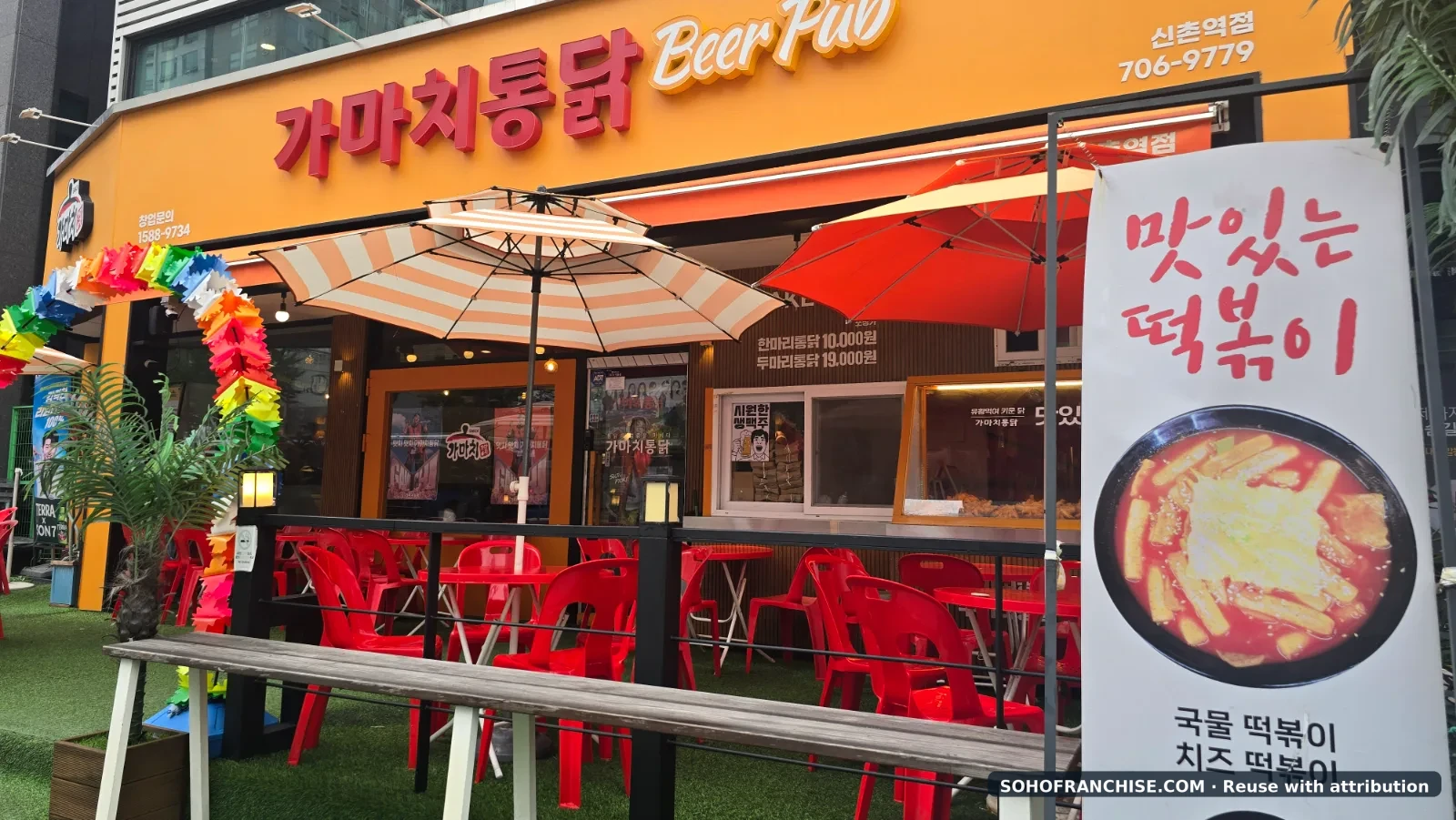
A visit to a chicken-and-beer restaurant near Sinchon Station in Seoul shows how the business itself is changing. Instead of being simply a delivery kitchen, the store combines fried chicken, tteokbokki, beer, outdoor seating and a casual neighborhood pub atmosphere.
This hybrid model may offer a clue to the future of Korea's chicken franchise industry.
Nearly 29,000 Franchise Chicken Stores
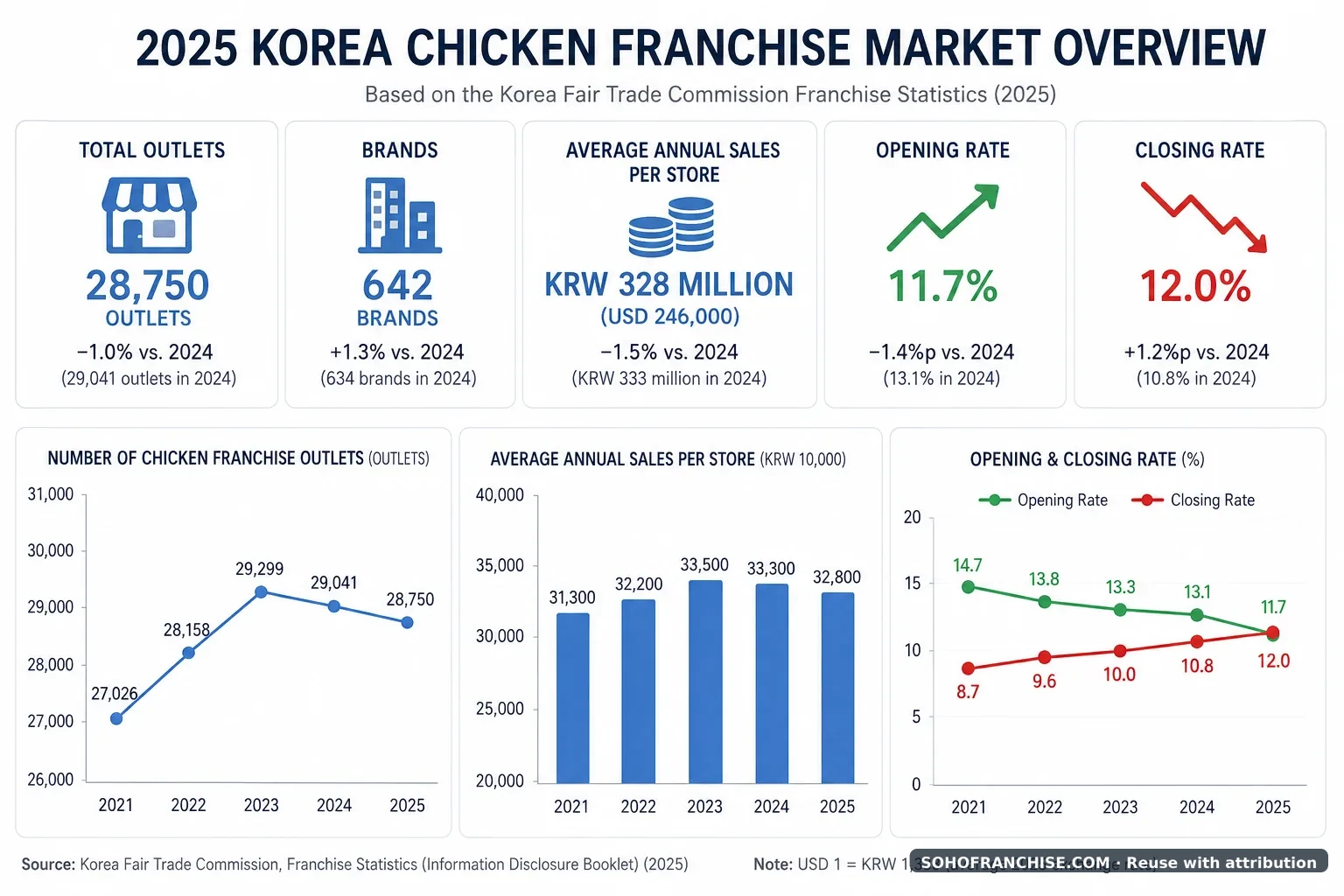
According to the Korea Fair Trade Commission's latest franchise statistics, Korea had approximately 28,750 chicken franchise outlets.
The number is enormous for a country of roughly 50 million people and demonstrates how deeply chicken has become embedded in Korea's food-service industry.
| Indicator | Korean Chicken Franchise Market |
|---|---|
| Franchise outlets | Approximately 28,750 |
| Registered chicken brands | More than 600 |
| Average annual franchise-store sales | Approximately KRW 328 million |
| New-store opening rate | 11.7% |
| Closure rate | 12.0% |
The numbers reveal something important.
Chicken remains a huge business, but it is no longer an automatically growing market.
The number of chicken franchise stores has recently declined while Korean-food restaurants and coffee franchises continued to expand. In other words, the chicken sector appears to be entering a more mature phase in which stronger stores survive while weaker locations disappear.
A KRW 328 Million Store Is Not a KRW 328 Million Income
This distinction is particularly important for retirees.
An average annual franchise-store revenue of around KRW 328 million may initially sound attractive. That represents roughly KRW 27 million in monthly sales.
But sales are not profit.
From that revenue, an operator must pay for chicken, cooking oil, sauces, packaging materials, beverages, rent, electricity, gas, franchise-related costs, delivery-platform expenses, card fees and labor.
The owner ultimately receives what remains after all these expenses.
For a retiree investing a substantial portion of retirement savings, revenue alone is therefore one of the least useful numbers when evaluating a franchise.
The more important question is:
How much operating cash remains after all expenses — and how many hours must the owner personally work to earn it?
Why Chicken Was So Attractive to Retirees
There were good reasons why chicken became Korea's classic retirement business.
- Consumers already understood the product.
- The menu was relatively standardized.
- Franchise headquarters supplied recipes and ingredients.
- Restaurants could operate from relatively small spaces.
- Delivery expanded the potential trading area.
- Chicken had demand from children, families, office workers and late-night customers.
For someone leaving a corporate career without restaurant experience, these characteristics made franchising much easier than developing an independent restaurant from zero.
The franchise system effectively transferred some of the complexity from the individual owner to the headquarters.
But Today's Retiree Faces a Different Market
Korea's first major baby-boom generation, generally defined as people born between 1955 and 1963, is now moving deep into retirement age.
Many members of this generation possess something extremely valuable: capital, professional experience and decades of accumulated personal networks.
But restaurant operations also demand something that becomes more difficult with age — physical stamina.
A conventional chicken restaurant can involve preparation before opening, long periods of standing, handling hot cooking equipment, cleaning, ingredient management and late-night closing.
A chicken-and-beer pub can be even more demanding because the strongest sales period may begin in the evening and continue late into the night.
For this reason, SOHOFRANCHISE believes that the question should not simply be whether a chicken franchise is profitable.
The better question is whether the operating model is compatible with retirement.
The Full Beer-Pub Model May Not Be Ideal
The Sinchon restaurant photographed by SOHOFRANCHISE illustrates an interesting evolution of Korean chicken culture.
Chicken is no longer just a food product. Combined with beer, outdoor seating and inexpensive Korean comfort food, it becomes a neighborhood social experience.
This can increase average customer spending and reduce dependence on delivery platforms.
However, a large dine-in beer-pub format also brings disadvantages for older owner-operators:
- More tables require more cleaning and service.
- Alcohol sales extend operating hours.
- A larger store increases rent.
- More menu items increase kitchen complexity.
- Additional employees may be necessary.
Therefore, the most attractive concept for a retiring baby boomer may actually be a smaller version of this model.
A Better Retirement Chicken Model?
SOHOFRANCHISE sees potential in a small, owner-operated neighborhood chicken shop rather than a large conventional restaurant.
| Traditional Chicken Pub | Retirement-Oriented Model |
|---|---|
| Large dining area | Small footprint |
| Many tables | Limited seating |
| Large menu | Focused menu |
| Late-night operation | Earlier closing time |
| Several employees | Owner or couple-operated |
| High rent location | Neighborhood residential market |
| Heavy delivery dependence | Takeout + local delivery + small dine-in |
Imagine a 10-to-15-pyeong store operated by a retired couple.
The menu might consist of three or four chicken products, tteokbokki, fries and bottled or draft beer. Customers could order takeout, while perhaps 15 to 20 seats serve neighborhood residents.
Such a business would sacrifice maximum revenue in exchange for lower rent, fewer employees and simpler operations.
For a retiree, that may actually represent a better business.
Location Is More Important Than Brand
In a saturated market, another mistake is assuming that a famous franchise name guarantees success.
It does not.
A strong brand can generate customer recognition, but the economics of an individual store still depend heavily on rent, nearby households, competing restaurants, pedestrian traffic, delivery demand and operating costs.
A KRW 500 million store with extremely high rent and payroll can potentially generate less owner income than a KRW 300 million neighborhood store operated by a couple in a low-rent location.
For retirees, therefore, profitability per invested won may be more important than total sales.
Do Not Invest All Retirement Savings
This may be the single most important consideration.
Restaurant investment should never be treated as a substitute for a pension.
Retirement capital has a different economic purpose from entrepreneurial capital. Once retirement savings are lost, the time available to rebuild them is limited.
A prospective franchisee should therefore calculate not only the expected return but also the financial consequences if the store closes after two or three years.
Before signing a franchise agreement, retirees should examine:
- Total initial investment
- Deposit and monthly rent
- Royalty and required purchases
- Actual food-cost ratio
- Required staffing
- Delivery-platform dependency
- Average sales of comparable stores
- Closure rate
- Contract termination conditions
- Expected resale value of the store
SOHOFRANCHISE View: Recommended, But Only Selectively
Is the Korean chicken franchise still a business SOHOFRANCHISE would recommend to baby-boom retirees?
Yes — but no longer as a default retirement strategy.
Korea's chicken market is too mature and too competitive for the old formula of simply choosing a famous brand, renting a store and expecting steady income.
However, chicken has one major advantage that should not be underestimated: Koreans continue to eat it across generations.
The product itself is unlikely to disappear.
What must change is the business model.
For a retiree, the most sensible opportunity may be a small neighborhood store with modest rent, limited seating, a simple menu and enough takeout business to operate with one or two owners and minimal employees.
The objective should not be to build the highest-revenue chicken restaurant in the district.
It should be to create a manageable small business that produces sustainable cash flow without consuming the owner's entire retirement life.
That distinction may determine whether Korea's traditional post-retirement chicken shop survives into the next generation.
Field photo: A neighborhood chicken-and-beer franchise near Sinchon Station, Seoul. Photo by SOHOFRANCHISE, September 2026.