
Korea Has Become a Coffee Nation
Coffee is now deeply embedded in Korean daily life.
Office workers buy coffee on the way to work. Students use cafés as study spaces. Tourists search for distinctive cafés on social media. Neighborhood residents often have several coffee shops within walking distance.
Korea has developed one of the world’s densest café markets, and recent industry data suggests that the period of simple expansion may be approaching its limit.
The important change is that the market is moving from:
Expansion
to:
Selection and Consolidation
The total number of cafés may be approaching saturation, but strong franchise systems are still opening stores and competing for a larger share of the market.
Franchise Coffee Is Still Expanding
Large coffee franchises have several structural advantages over individual operators.
They can centralize purchasing, marketing, menu development, store design and technology.
A successful system created by headquarters can be deployed across hundreds or even thousands of stores.
This gives franchise chains advantages in areas such as:
- Centralized purchasing
- National marketing
- Standardized menus
- Store-design systems
- Mobile ordering
- Loyalty programs
- Staff training
- Inventory management
- Real-estate analysis
Independent cafés normally cannot match this scale.
However, that does not mean independent cafés will disappear.
It means they need to compete differently.
Major Coffee Brands in Korea
The major brands illustrate how several different coffee-business models now coexist in Korea.
| Brand | Approx. Korea Store Base | Market Position | Main Model |
|---|---|---|---|
| MEGA MGC Coffee | 3,325 franchise stores | Value leader | Low-price / High-volume |
| Compose Coffee | 2,649 franchise stores | Value | Takeaway / Fast turnover |
| Ediya Coffee | 2,562 franchise stores | Mid-market | Neighborhood café |
| Starbucks Korea | 2,160 stores | Premium | Company-operated / Experience |
| Paik’s Coffee | 1,712 franchise stores | Value | Low-price / Takeaway |
| A Twosome Place | 1,510 franchise stores | Premium café | Dessert / Seating |
The figures above are useful for understanding market scale, although their reference periods are not exactly identical.
The franchise-store figures mainly reflect recent franchise disclosure data, while the Starbucks number represents a later store count.
Starbucks Korea is also structurally different because its Korean stores are company-operated rather than franchised.
The comparison nevertheless reveals an important point:
Korea does not have one coffee market. It has several coffee markets operating at the same time.
MEGA MGC Coffee Represents the New Mass-Market Model
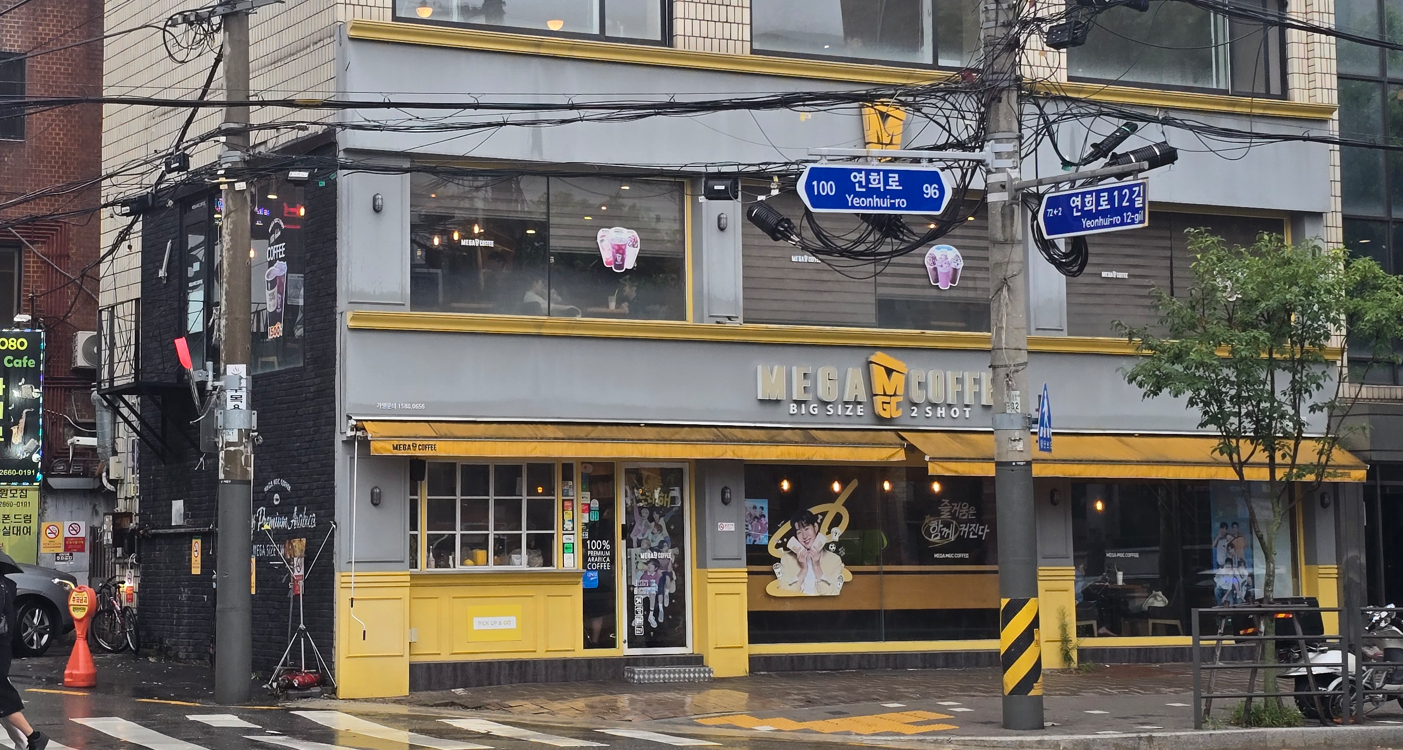
The accompanying photograph of a MEGA MGC Coffee store illustrates one of the most visible changes on Korean streets.
MEGA MGC Coffee has built a highly recognizable business around a simple formula:
Low Price + Large Drink + Fast Service + Compact Store + High Volume
Many customers do not enter the store to spend an hour drinking coffee.
They enter, order, receive the drink and leave.
This means a relatively small retail space can process a large number of transactions.
In business terms, the modern low-price café increasingly resembles a beverage convenience store.
The KRW 2,000 Coffee Changed Consumer Expectations
One of the biggest changes in Korea’s coffee market has been the normalization of inexpensive daily coffee.
MEGA MGC Coffee, Compose Coffee and Paik’s Coffee helped make the low-priced iced Americano an everyday product.
Their model can be simplified as:
Lower Price + Higher Purchase Frequency + Faster Turnover
This format is particularly effective around:
- Subway stations
- Office districts
- Universities
- Residential intersections
- Bus stops
- High-footfall shopping streets
A customer may hesitate to spend KRW 5,000 on coffee every day.
A coffee around KRW 2,000 creates a very different purchasing decision.
It can become a daily habit.
Store Count Does Not Equal Profitability
A large franchise network does not automatically mean every franchise store is highly profitable.
Coffee-store economics depend on many factors.
The important calculation is:
Sales − Rent − Labor − Ingredients − Franchise Costs = Actual Store Profitability
A low-price coffee store may require extremely high transaction volume.
A premium café may have higher rent and a larger footprint but can generate a higher average transaction value.
For potential franchisees, store count alone is therefore not enough.
They need to understand the operating economics of an individual unit.
A Twosome Place Shows a Different Business Model
A Twosome Place represents a very different café strategy from MEGA MGC Coffee.
Its stores are generally larger.
Desserts are important.
Customers tend to stay longer.
The average transaction value can therefore be significantly higher.
The comparison between the two concepts is useful.
MEGA MGC Coffee focuses heavily on:
Transaction Volume
A Twosome Place focuses more on:
Customer Value per Visit
Both businesses sell coffee.
But their real-estate, staffing and revenue models are fundamentally different.
Starbucks Shows That Premium Coffee Still Works
The rapid growth of low-price coffee does not mean Korean consumers only want cheap coffee.
Starbucks Korea continues to maintain a very large store network despite significantly higher prices than budget coffee chains.
Its competitive strengths include:
- Strong brand recognition
- Prime locations
- Comfortable seating
- Mobile ordering
- Loyalty programs
- Consistent customer experience
This suggests that Korea’s coffee market is increasingly becoming polarized.
At one end:
Affordable everyday coffee
At the other:
Premium branded and experience-oriented cafés
The middle of the market may become increasingly difficult.
Why the Middle Market Is Under Pressure
Imagine a customer who mainly wants caffeine and convenience.
That customer can choose MEGA MGC Coffee, Compose Coffee or Paik’s Coffee.
Now imagine a customer who wants a meeting place, dessert or premium café environment.
That customer may choose Starbucks, A Twosome Place or an attractive independent café.
This creates a difficult position for brands in the middle.
A coffee business increasingly needs to explain either:
Why it is cheaper
or:
Why it is worth paying more for
Without a clear answer, the concept can become vulnerable.
Independent Cafés Cannot Win on Scale
Independent cafés usually cannot compete with national chains in:
- Purchasing power
- National advertising
- Mobile applications
- Loyalty programs
- Celebrity marketing
- Centralized product development
- Real-estate scale
Trying to defeat MEGA MGC Coffee purely on price is therefore extremely difficult.
But independent cafés have one important advantage.
They do not have to be standardized.
Independent Cafés Are Becoming Experience Businesses
The strongest independent cafés increasingly sell much more than coffee.
They sell:
- Architecture
- Interior design
- Specialty beans
- Bakery products
- Photography
- Music
- Neighborhood identity
- Local culture
- Views
- Social-media experiences
This is particularly visible in Seoul.
Districts such as Seongsu, Yeonnam, Ikseon-dong, Bukchon and Seochon contain cafés that function partly as destinations.
Customers may travel across Seoul specifically to experience one café.
The café itself becomes the product.
Busan Has a Different Café Advantage
Busan has developed another form of café culture.
Areas such as Jeonpo, Gwangalli, Haeundae and Yeongdo combine coffee with lifestyle, tourism and scenery.
An independent café overlooking the sea can offer something a standardized nationwide chain cannot easily reproduce.
The building, neighborhood and view become part of what the customer is buying.
This can make destination cafés particularly powerful in Busan.
Franchise Coffee vs. Independent Coffee
The difference between the two models can be summarized simply.
| Business Factor | Franchise Café | Independent Café |
|---|---|---|
| Main Strength | Consistency | Uniqueness |
| Pricing | Standardized | Flexible |
| Purchasing Power | High | Relatively low |
| Branding | National | Local / Personal |
| Expansion | Highly repeatable | Difficult to replicate |
| Customer Motivation | Convenience / Habit | Discovery / Experience |
| Technology Investment | Strong | Smaller but improving |
| Best Location Type | Office / Transit / Residential | Lifestyle / Tourism / Destination |
| Main Competitive Risk | Intense chain competition | Owner dependence / Operating risk |
This is why franchise and independent cafés can continue to coexist.
They increasingly solve different customer needs.
Franchise Coffee Sells Consistency
The biggest franchise advantage can be summarized in one word:
Consistency
The customer knows what to expect.
The menu is familiar.
The price is recognizable.
Payment is simple.
The drink is standardized.
For routine daily consumption, this is extremely powerful.
An office worker usually does not want to research a new café every morning.
They want coffee that is familiar, affordable and fast.
Independent Coffee Sells Difference
Independent cafés operate according to almost the opposite logic.
Their competitive advantage is:
Difference
A strong independent café can be defined by:
- A particular building
- A particular owner
- A particular roasting style
- A particular dessert
- A particular neighborhood
- A particular view
- A particular atmosphere
The customer is not simply buying coffee.
The customer is choosing that particular café.
Tourism Can Strengthen Both Models
International tourism creates opportunities for both franchise chains and independent cafés.
Foreign travelers often appreciate recognizable brands because ordering is easy, prices are clear and the environment feels familiar.
At the same time, tourists actively search for cafés that they cannot experience at home.
A visitor may travel to Seochon for a hanok café.
Another may visit Seongsu for a converted industrial building.
In Busan, a tourist may choose a café specifically because it overlooks the ocean.
Franchise cafés therefore provide:
Familiarity
Independent cafés provide:
Discovery
Both can benefit from growing international tourism, but in different ways.
AI and Automation Will Change the Coffee Business
Technology will become another important competitive factor.
Large franchise systems can deploy technology across thousands of locations.
Potential applications include:
- Mobile ordering
- AI demand forecasting
- Automated inventory management
- Digital loyalty programs
- Self-order kiosks
- Semi-automated beverage preparation
- Centralized sales analysis
Once headquarters develops a successful system, it can distribute that system throughout the network.
This creates a significant scale advantage.
AI Can Also Help Independent Cafés
However, AI may also reduce some of the disadvantages faced by small operators.
Independent café owners can increasingly use affordable AI tools for:
- Social-media content
- Menu translation
- Graphic design
- Staff scheduling
- Inventory planning
- Customer communication
- Sales analysis
Tasks that previously required several outside specialists can increasingly be handled by a small business owner using software.
This could help strong independent concepts remain competitive.
Seoul and Busan Will Develop Differently
Seoul and Busan should not be viewed as identical coffee markets.
Seoul combines extremely dense:
- Office traffic
- Subway traffic
- University demand
- Residential demand
- Tourist traffic
This creates strong conditions for fast, affordable franchise coffee.
At the same time, neighborhoods such as Seongsu, Bukchon and Seochon support highly differentiated independent cafés.
Busan has another advantage.
Its coffee business can be closely connected with:
- Sea views
- Leisure
- Weekend travel
- Tourism
- Architecture
For this reason, a business model that works beside a Seoul subway station may be completely different from a successful concept in Gwangalli or Yeongdo.
Korea Is Moving From Expansion to Selection
For many years, Korea’s café market appeared capable of continuous expansion.
That phase may now be ending.
The next stage may look more like:
Weak cafés close
Strong franchise systems gain market share
Strong independent cafés become destinations
Unclear mid-market concepts face increasing pressure
This could ultimately create a more polarized but more professional coffee market.
What Foreign Coffee Franchises Should Learn
For international coffee brands considering Korea, there is an important lesson.
A large coffee market does not necessarily mean an easy coffee market.
Korea already has:
- Powerful domestic franchises
- Starbucks
- Aggressive low-price chains
- Sophisticated consumers
- High commercial rents
- Thousands of creative independent cafés
A foreign coffee franchise therefore needs to answer one simple question:
Why should a Korean consumer choose this brand?
Coffee alone may not be enough.
Price alone may not be enough.
Interior design alone may not be enough.
The concept needs a clearly differentiated reason to exist.
SOHOFRANCHISE View
Korea’s coffee market is increasingly dividing into two strong directions.
Franchise cafés compete through:
Scale
Systems
Price
Convenience
Consistency
Independent cafés compete through:
Identity
Experience
Design
Location
Uniqueness
Neither model is likely to eliminate the other.
Instead, they are becoming more specialized.
The greatest pressure may fall on coffee businesses that have no clear position between the two.
Sometimes customers are buying a low-cost caffeine solution.
Sometimes they are buying a premium branded environment.
And sometimes they are buying a memory of a place they may never visit again.
In Korea’s next coffee chapter, the real competition is not simply coffee versus coffee.
It is Standardization versus Identity.