
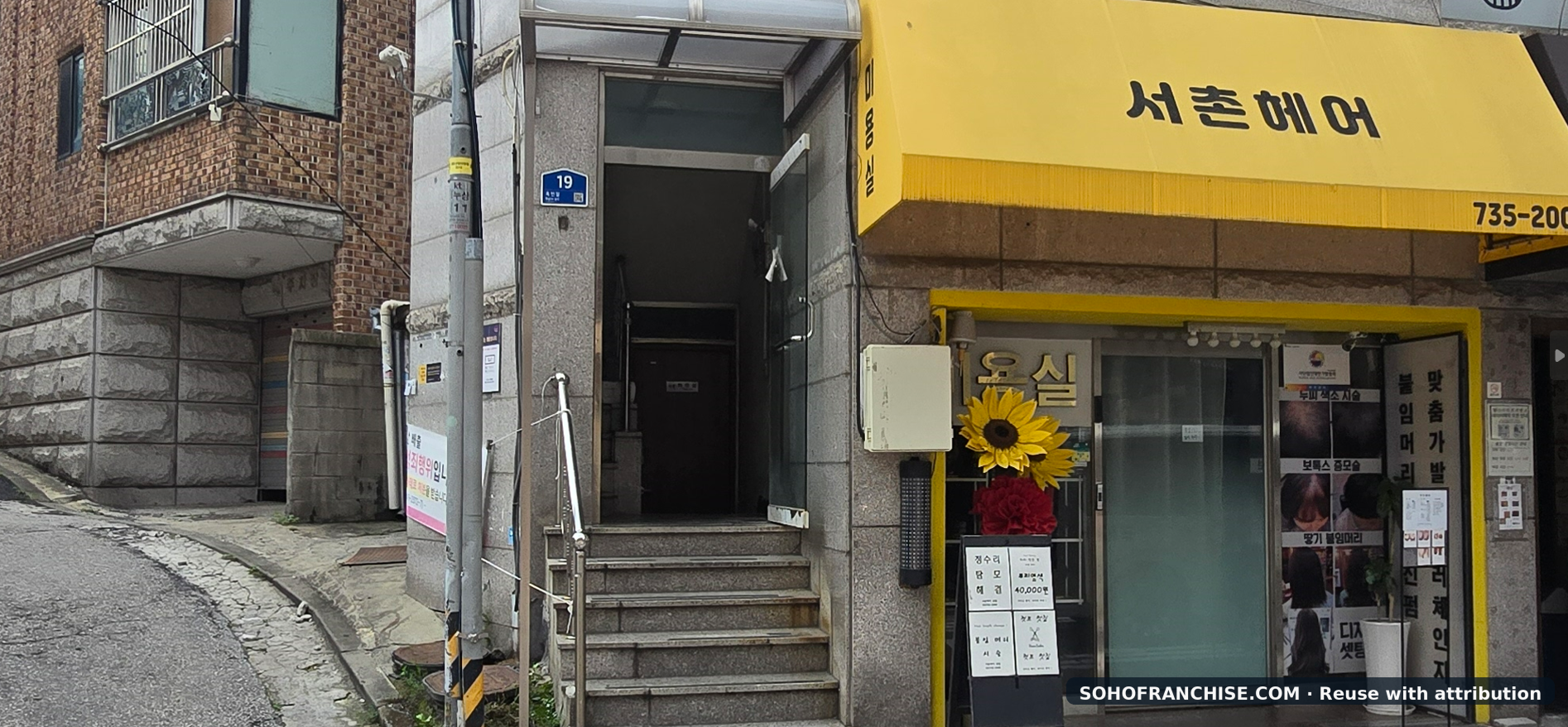
Korea has one of the most competitive hair salon markets in Asia. Hair salons can be found in almost every residential neighborhood, subway commercial district and shopping street, ranging from single-stylist shops to large multi-branch beauty brands.
But the market is increasingly dividing into three very different business models: large franchise and branded salons, thousands of independent neighborhood salons, and a rapidly emerging premium K-beauty salon market centered around Gangnam, Cheongdam and Apgujeong.
For entrepreneurs and franchise operators, this fragmentation may create new opportunities rather than simply more competition.
A Huge Market Still Dominated by Small Operators
According to Statistics Korea figures cited from the nationwide business census, Korea had more than 110,000 hairdressing establishments employing roughly 156,000 people.
This means the average salon has only around 1.4 workers, showing how strongly Korea's hair industry is dominated by micro-businesses and owner-operated salons.
The typical neighborhood salon is therefore very different from the large beauty salons found around Gangnam Station, Cheongdam, Apgujeong or major department-store districts.
Many local salons operate with only the owner, or the owner plus one assistant. Their biggest advantage is a relatively simple cost structure: small premises, limited payroll and a loyal customer base living within walking distance.
For experienced stylists, the one-person salon model can be particularly attractive. A stylist leaving a large salon may already have hundreds of customers following his or her Instagram, Naver profile or Kakao channel.
Instead of paying for a large shop and multiple employees, the stylist can open a small appointment-based salon and retain a larger share of service revenue.
Digital reservation systems also strengthen this model. A one-person salon no longer requires a receptionist, large waiting room or expensive high-traffic location if most customers arrive through scheduled reservations.
Franchised Hair Salons Are Growing
The franchise segment remains much smaller than Korea's overall salon market, but it continues to expand.
| Indicator | 2023 | 2024 | Change |
|---|---|---|---|
| Franchised hair salon establishments | 4,718 | 5,024 | +6.5% |
| Workers | 22,114 | 23,246 | +5.1% |
| Annual sales | KRW 1.491 trillion | KRW 1.607 trillion | +7.8% |
| Average annual sales per outlet | KRW 316.0 million | KRW 319.8 million | +1.2% |
| Workers per outlet | 4.69 | 4.63 | -1.3% |
Source: Statistics Korea, Preliminary Results of the 2024 Franchise Survey.
The figures show an interesting trend. The number of franchised hair salons increased much faster than average sales per outlet.
This suggests that franchise networks are expanding their physical footprints, but adding more stores does not automatically produce higher productivity.
Hair salons are fundamentally different from coffee shops, convenience stores or fast-food restaurants. A haircut, perm or hair color cannot be completely standardized because customers ultimately purchase the skill, judgment and personality of an individual stylist.
This makes the stylist, rather than the signboard, the core asset of the business.
Franchise Versus Independent Salon
| Business Model | Main Advantage | Main Weakness |
|---|---|---|
| Large Franchise Salon | Brand recognition, training, recruitment, CRM, purchasing and marketing systems | High payroll, rent and operating costs |
| Independent Multi-Stylist Salon | Owner control and strong local branding | Dependence on attracting and retaining designers |
| One-Person Neighborhood Salon | Low labor cost, loyal customers and high owner control | Revenue limited by available working hours |
| Luxury Tourist Salon | High customer spending and K-beauty experience revenue | Requires international marketing, language support and premium location |
Why Gangnam Could Become a Luxury Hair Market
The most interesting new growth opportunity may come from international tourism.
Seoul is experiencing a strong recovery in international tourism, while spending by foreign visitors is rising even faster than visitor numbers.
Beauty-related spending is becoming an increasingly important part of that growth, and Gangnam already captures one of the largest shares of foreign visitor spending in Seoul.
This matters because Gangnam is not simply a shopping district.
Cheongdam, Apgujeong, Sinsa and Gangnam already combine luxury fashion, dermatology, plastic surgery, cosmetics, hotels, restaurants and entertainment.
Hair services can naturally become another part of this K-beauty ecosystem.
From Haircut to K-Beauty Experience
A tourist visiting Korea may not originally plan to visit a hair salon. However, the growing international popularity of Korean fashion, K-pop, dramas and beauty can transform an ordinary salon service into a tourism experience.
Potential premium services include:
- Korean-style layered cuts
- Digital and volume perms
- Personal-color-based hair coloring
- Scalp diagnosis and premium head spa
- Hair treatment and anti-aging scalp care
- K-pop or Korean actor-inspired styling
- Hair and makeup packages for photography
- Wedding and profile-photo styling
Selected salons in Cheongdam and Gangnam already show how premium pricing can move far beyond the traditional neighborhood salon model.
Premium colors and perms can be priced in the KRW 200,000 to KRW 400,000 range, while combined head-spa, scalp-care and treatment programs can reach KRW 300,000 to more than KRW 500,000.
These prices should not be regarded as a market-wide average. However, they demonstrate that the customer purchasing a premium Seoul beauty experience may not compare the service with a KRW 20,000 neighborhood haircut.
Instead, international visitors may compare it with luxury beauty and wellness experiences in Tokyo, Singapore, New York, Paris or Los Angeles.
Medical Tourism Creates a Powerful Adjacent Market
Gangnam already attracts hundreds of thousands of international medical tourists, with dermatology and plastic surgery accounting for a particularly large portion of foreign patient visits.
This means many international visitors are already traveling to Gangnam with beauty, appearance and personal care as part of the purpose of their trip.
Hair salons therefore have access to a valuable adjacent customer base.
A traveler spending heavily on hotels, shopping, skincare or cosmetic procedures may also be willing to spend KRW 200,000 to KRW 400,000 on a premium Korean hair, scalp and styling experience if the service is convenient and professionally marketed.
The Real Product May Be Convenience
For international customers, the winning salon may not necessarily be the salon with the most famous Korean stylist.
It may be the salon that makes the entire customer journey easiest.
A tourism-oriented salon should consider English, Japanese and Chinese booking pages, transparent pricing, international credit cards, clear service durations, before-and-after photographs and staff who can provide consultations without depending entirely on translation applications.
Salons could also develop partnerships with hotels, dermatology clinics, medical tourism agencies, photographers, wedding companies and travel platforms.
In this business model, the salon becomes part hair business, part beauty spa and part tourism business.
A New Franchise Opportunity: Networks for One-Person Salons
There may also be a large franchise opportunity hidden inside Korea's enormous independent salon market.
Trying to standardize how every stylist cuts hair is difficult. But a franchise or membership network does not necessarily need to standardize the haircut itself.
Instead, it can standardize everything around the stylist.
- Brand identity
- Online reservation systems
- Customer relationship management
- Multilingual websites
- Training and certification
- Hair-care product purchasing
- Interior design
- Digital marketing
- Tourist reservations
- Payment systems
- Customer reviews
This could create a new type of micro-franchise in which independent stylists maintain their own creative identity while sharing technology, purchasing, marketing and brand infrastructure.
SOHOFRANCHISE Outlook
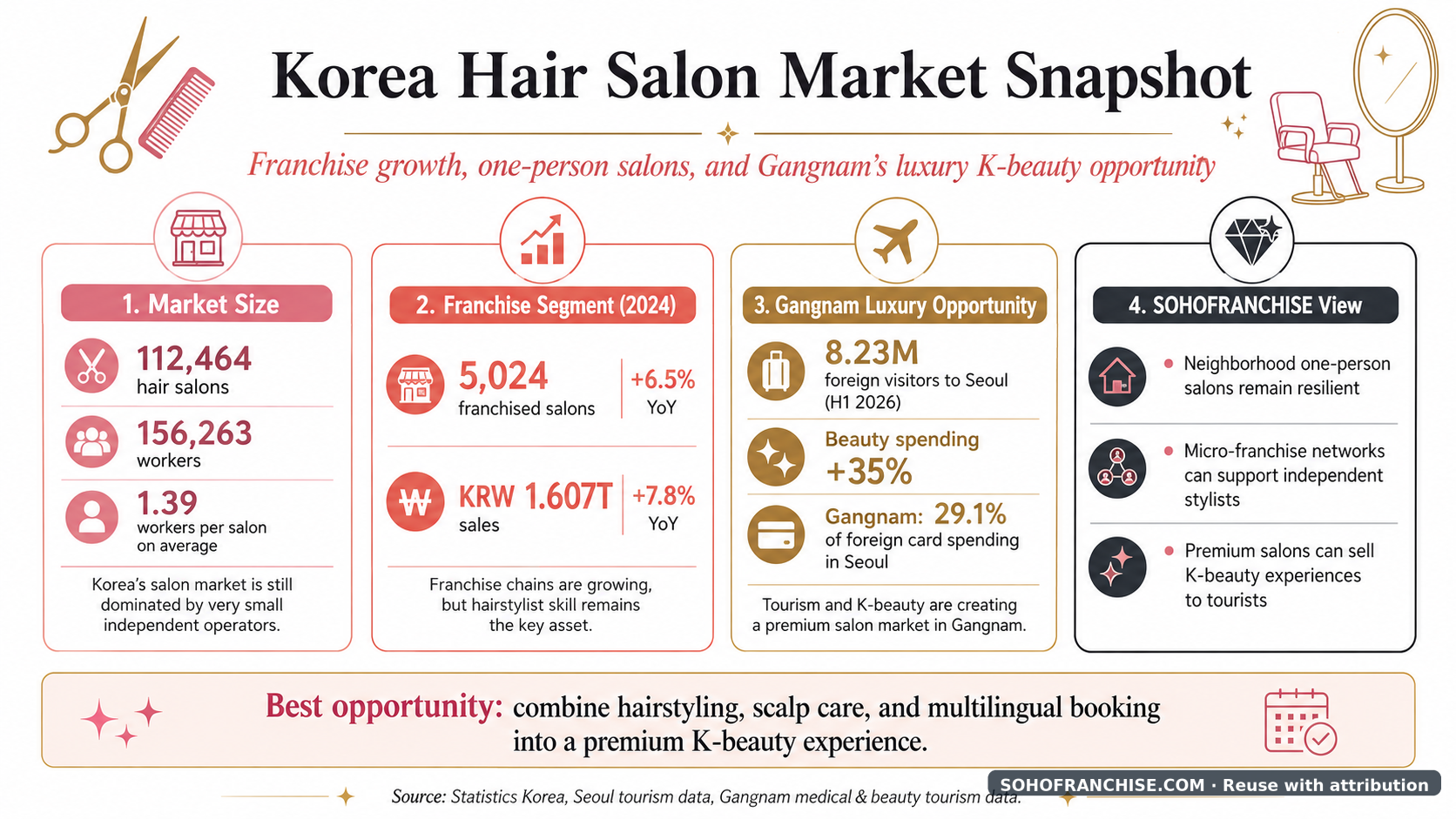
Korea's hair salon industry is unlikely to become completely dominated by large chains.
The economics of the market favor both large brands and very small operators.
Neighborhood customers will continue to support one-person salons because convenience, trust and personal relationships remain extremely important.
Large franchise salons will continue to grow because they provide training, brand recognition, purchasing power and a career structure for young designers.
But the most interesting new opportunity may develop above both markets.
As Korean tourism enters another expansion cycle and global interest in K-beauty continues to rise, Cheongdam, Apgujeong, Sinsa and other premium Seoul districts could develop a much larger market for luxury hair, scalp care, styling and beauty experiences aimed specifically at international visitors.
The future premium Korean salon may therefore look less like a traditional neighborhood hair shop and more like a combination of a hair studio, beauty spa, personal styling studio and tourism destination.
For franchise investors, the opportunity is not simply to open more salons.
The bigger opportunity may be to turn Korean hairstyling itself into an exportable K-beauty experience.
Sources & Methodology: Statistics Korea Franchise Survey; Statistics Korea nationwide business census data; Seoul Metropolitan Government tourism statistics; Gangnam Medical Tour statistics; Korean small-business industry guidance; published service menus from selected Gangnam and Cheongdam salons. Total-market and franchise figures originate from different statistical surveys and reference years and should not be interpreted as directly comparable market-share figures.