
One Street Scene Explains the New Tourism Economy
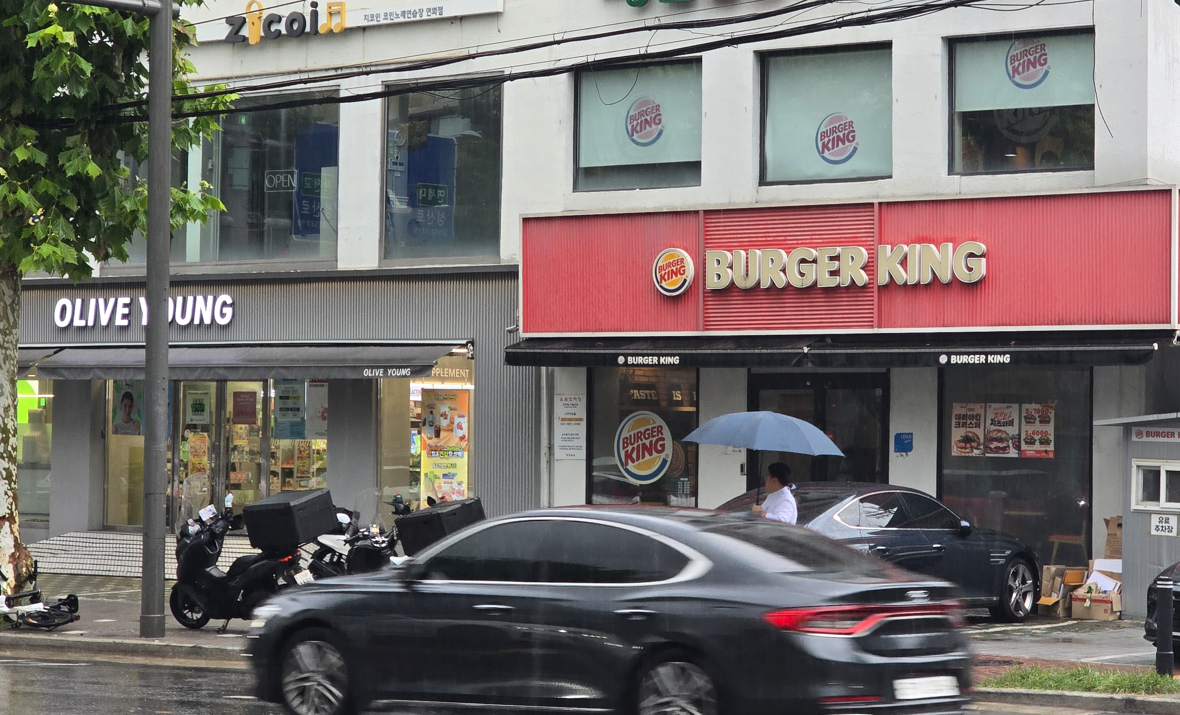
The accompanying street photograph captures an increasingly common scene in Korea.
An Olive Young store and a Burger King operate almost side by side.
At first glance, they belong to completely different industries.
One sells Korean beauty and lifestyle products.
The other sells hamburgers.
But from the perspective of international tourism, they are serving different parts of the same customer journey.
A foreign visitor may spend the afternoon shopping for Korean cosmetics and then choose a globally familiar fast-food restaurant for a quick meal.
This combination illustrates an important change in Korean retail.
Tourism is no longer limited to hotels, duty-free stores and famous attractions.
It is becoming embedded in ordinary urban commerce.
Seoul Is Already Becoming a Global Consumer City
The scale of the change is visible in the latest Seoul tourism data.
During the first six months of 2026, Seoul received approximately 8.23 million foreign visitors, up 21.3% from a year earlier.
More importantly, their card spending reached approximately KRW 5.62 trillion.
Visitor numbers increased 21.3%, but spending increased 56.8%.
Average card spending per foreign visitor rose from roughly KRW 530,000 to KRW 680,000.
This means the value of each visitor is increasing faster than the visitor count itself.
Shopping accounted for 46.4% of foreign tourist card spending in Seoul.
Food and beverage represented another 13.1%.
Together, these two sectors accounted for almost 60% of foreign visitor spending outside categories such as healthcare, wellness and accommodation.
For retail and restaurant operators, these numbers are becoming impossible to ignore.
Olive Young Is Probably the Clearest Example
Olive Young demonstrates how dramatically tourism can change a domestic retail business.
In the first half of 2025, foreign customers accounted for 26.4% of the company's offline sales based on tax-refund transactions.
By the second quarter, the ratio had reached approximately 30%.
Even more striking, CJ Olive Young reported that more than eight out of every ten international visitors to Korea during the January-May 2025 period made a purchase at an Olive Young store.
Approximately 7.21 million foreigners visited Korea during that period, while around 5.96 million foreign customers purchased from Olive Young.
That is no longer simply additional tourist business.
Foreign visitors have become one of the company's core customer groups.
Myeongdong Shows What Happens at Tourist Saturation
The effect becomes even more dramatic when we look at individual tourist districts.
CJ has said that roughly 95% of purchases at Olive Young stores in Seoul's Myeongdong commercial district can come from international customers.
That effectively transforms what appears to be a Korean neighborhood retail store into an inbound export platform.
The merchandise is purchased in Korea, but the ultimate consumer comes from another country.
Tourists then carry Korean beauty brands back to Japan, Taiwan, China, Southeast Asia, the United States and Europe.
From a business perspective, the store functions simultaneously as a retailer, showroom, marketing platform and global product-discovery center.
Busan Is Entering the Same Cycle
Seoul remains Korea's dominant international tourism market, but Busan may represent the more interesting growth opportunity.
Busan recorded approximately 3.02 million international visitors by the end of October 2025 and estimated that the full-year figure would reach approximately 3.5 million.
The city is already targeting 5 million foreign visitors and KRW 1.5 trillion in annual foreign tourist spending by 2028.
Growth has continued into 2026.
Through May, Busan recorded approximately 1.94 million foreign visitors, around 40% more than the same period a year earlier.
Foreign visitor spending during those five months reached approximately KRW 486.8 billion.
The visitor mix is also increasingly international.
Taiwan, China, Japan and the United States are major source markets, while visitors from Southeast Asia and Europe are also expanding.
For franchise and chain-store operators, that diversification is valuable because it reduces dependence on a single tourist nationality.
Olive Young Is Already Seeing the Busan Effect
Olive Young's own data provides additional evidence.
The company designated more than 110 locations around Korea as global tourism commercial-zone stores, including locations in Seoul and Busan.
These stores use multilingual information, tourist-oriented merchandising, tax-refund services and other features specifically designed for international shoppers.
In early 2025, foreign sales at stores in areas including Haeundae, Busan, recorded triple-digit year-on-year growth.
This is important.
It suggests that K-beauty tourism is no longer a Myeongdong-only phenomenon.
As international tourism spreads geographically, the retail opportunity spreads with it.
Haeundae, Seomyeon, Gwangalli, Nampo-dong and the areas around Busan Station and major cruise routes could increasingly support the same type of international retail ecosystem already visible in central Seoul.
Burger King Benefits From a Different Tourist Need
There is no publicly disclosed Burger King Korea data showing what percentage of its Korean sales comes directly from foreign tourists.
Therefore, it would be wrong to claim that Burger King currently receives the same direct tourism effect as Olive Young.
However, broader Seoul tourism spending provides a useful indicator.
Foreign visitors spent approximately KRW 584.3 billion at restaurants in Seoul during the first half of 2026, up 54.5% from the same period a year earlier.
Food and beverage represented 13.1% of total foreign visitor card spending.
That creates a large addressable market for restaurant chains located in high-tourism districts.
A global QSR brand has another advantage.
International travelers already understand the brand, ordering process and basic menu before entering the restaurant.
This reduces what might be called the "tourist decision cost."
A visitor unfamiliar with Korean food may still want Korean cuisine for dinner, but during a busy sightseeing day may choose a familiar hamburger for lunch because it is fast, predictable and easy.
Global Brands and Korean Brands Play Different Roles
Olive Young and Burger King therefore benefit from inbound tourism in different ways.
Olive Young represents destination consumption.
Visitors may specifically plan to visit the store because purchasing Korean cosmetics is part of the travel experience itself.
Burger King represents convenience consumption.
The customer is already in the district and needs a meal, a place to sit, a familiar ordering process or a predictable product.
Both can benefit from the same pedestrian traffic.
This is why tourist-heavy commercial districts often develop powerful clusters of beauty, fashion, convenience stores, cafés, fast food, restaurants, photo booths and experience-based retail.
One tourist creates demand across multiple businesses during the same day.
What If Foreign Tourism Triples by 2030?
Now consider a more aggressive scenario.
This is not an official government forecast.
It is a SOHOFRANCHISE scenario designed to examine what could happen if international visitor volume in Seoul and Busan were more than three times today's level by 2030.
Using Seoul's first-half 2026 numbers as a simple baseline, 8.23 million foreign visitors would become approximately 24.7 million visitors over the equivalent six-month period.
If spending per visitor simply remained at today's level, KRW 5.62 trillion of foreign card spending would become approximately KRW 16.85 trillion.
Applying today's spending mix to that scenario, shopping alone could represent approximately KRW 7.8 trillion over the equivalent six-month period.
Food and beverage could approach approximately KRW 2.2 trillion.
This calculation assumes no increase in per-visitor spending.
If spending per tourist continues rising, as it did between 2025 and 2026, the potential market could be substantially larger.
The Olive Young Scenario Becomes Extraordinary
The same thought experiment can be applied to Olive Young.
During the first five months of 2025, approximately 5.96 million foreign customers made purchases at Olive Young while Korea received around 7.21 million foreign visitors.
If visitor numbers tripled while Olive Young maintained a similar penetration rate, the theoretical customer opportunity would also move toward roughly three times today's level.
Real-world sales would not increase perfectly linearly.
Stores have capacity limits.
Popular locations can become overcrowded.
Inventory, checkout capacity and staffing become constraints.
But this is precisely why the tourism boom could drive additional investment.
Operators may need larger stores, more tourist-specialized locations, more self-checkout, faster tax-refund processing, multilingual digital displays and more sophisticated inventory planning.
Tourism growth therefore creates not only higher same-store sales but also demand for a different store format.
A 2030 Busan With More Than 10 Million Foreign Visitors
Busan offers another interesting scenario.
The city estimated approximately 3.5 million foreign visitors for 2025.
Tripling that figure would imply roughly 10.5 million annual international visitors.
That would fundamentally change the commercial geography of Korea's second-largest city.
Areas currently considered seasonal tourist districts could begin supporting year-round international retail.
Haeundae and Gwangalli would remain important, but international spending could spread further into Seomyeon, Nampo-dong, Busan Station and neighborhood commercial districts connected to hotels, cruises, festivals and cultural attractions.
For franchise operators, Busan could gradually move from being a domestic market with tourists to becoming a genuine international consumer market.
Location Strategy Will Change
If tourist numbers increase threefold, selecting a franchise location purely on the basis of local residential population will become increasingly insufficient.
A store may have only a modest local population around it but enormous transient pedestrian traffic.
Hotel rooms, subway exits, cruise terminals, airport connections, tourist bus routes, K-pop attractions, traditional markets and social-media destinations will become increasingly important inputs in location analysis.
The most valuable question may no longer be:
"How many people live within one kilometer?"
It may become:
"How many international consumers pass this storefront every day?"
Store Design Will Also Have to Change
A tourism-oriented Olive Young cannot operate exactly like a neighborhood Olive Young.
A tourism-oriented restaurant cannot operate exactly like a residential QSR.
International customers create different requirements.
Menus and product descriptions must be understandable without staff assistance.
Credit-card acceptance has to be seamless.
Digital ordering needs multiple languages.
Stores may need space for luggage.
Tax refunds matter in retail.
Fast turnover matters in food service.
Late-night opening may become more valuable in districts with hotels and nightlife.
Even restroom access, charging points and seating configuration can influence tourist choice.
The result is a new type of franchise design: the tourist-optimized urban store.
Tourism Can Change the Economics of Prime Rent
High rents in Myeongdong, Hongdae, Gangnam, Seongsu and Haeundae are normally viewed as a major disadvantage for franchise operators.
Tourism can change that calculation.
If a location generates much higher transactions per square meter because of continuous international pedestrian traffic, expensive rent can still produce attractive store economics.
This helps explain why large flagship stores are returning to tourist-heavy districts in Seoul.
A location becomes more than a sales outlet.
It becomes advertising visible to customers from dozens or even hundreds of countries.
For Korean brands, this international marketing value can justify investments that would look excessive if evaluated only on domestic sales.
But Not Every Franchise Will Benefit
A threefold increase in tourism does not mean every restaurant or retail store will triple its sales.
Tourism spending is highly concentrated geographically.
Seoul's foreign card spending remains especially concentrated in districts such as Gangnam, Jung-gu and Mapo.
Store concepts must also match tourist behavior.
A brand with a difficult ordering process, poor multilingual support or a product that requires extensive local knowledge may capture less of the increase.
Competition and rents will rise as well.
The winners will likely be businesses that combine strong locations with simple purchasing, high visibility, fast service and products that either represent Korea or provide travelers with trusted convenience.
Seoul and Busan Could Become Two Different Franchise Laboratories
Seoul and Busan should not necessarily follow the same strategy.
Seoul is developing into a high-volume global metropolitan tourism market driven by K-pop, beauty, fashion, healthcare, food, traditional culture and lifestyle districts.
Busan can combine beaches, food, cruises, festivals, film, nightlife and marine tourism with a lower-density urban environment.
For international franchise companies looking at Korea, this distinction matters.
Seoul may be the market for maximum global exposure.
Busan may become the market for faster tourism-driven growth and new location experimentation.
SOHOFRANCHISE View
The most important conclusion is not that Olive Young will sell more cosmetics or that Burger King will sell more hamburgers.
The larger change is that international tourists are becoming part of the permanent customer base of Korean cities.
Olive Young is one of the clearest examples of a Korean retail chain converting tourism into global brand expansion.
Burger King represents another side of the same market: a globally recognizable QSR format capable of absorbing growing international foot traffic.
If international arrivals in Seoul and Busan were to more than triple by 2030, tourism would no longer be a secondary consideration when evaluating franchise locations.
It could become one of the primary economic variables.
The photograph of Olive Young and Burger King sharing the same urban street therefore may be more than an ordinary Korean streetscape.
It could be an early image of what the commercial streets of Seoul and Busan increasingly look like in the global tourism era.